Thursday, January 15, 2009
Suskind: Bush Lacked Humility for the Presidency
The nation stands just four days away from inaugurating a new president. Of course, this is the glass is half-full argument. It sounds more uplifting than the glass is half-empty version manifested in the end of the troubled Bush presidency. Many journalists and television pundits have pressed to portray the inner psychological workings of George W. Bush. Filmmaker Oliver Stone bravely attempted to tell his story on the silver screen before time and history had made even a preliminary verdict on the last eight years.
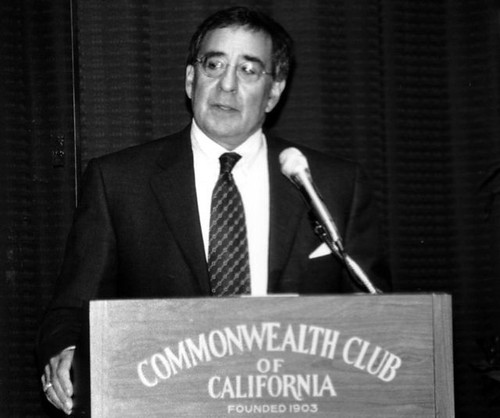
Speaking last night at The Commonwealth Club, journalist Ron Suskind made one of the most astute observations that goes to the root causes of Bush's tumultuous time in the White House. During the Q&A portion of the program, Suskind was asked to name names at the CIA who were involved in creating faulty intelligence regarding WMD in Iraq. Suskind sidestepped the question, but he conjured a revealing portrait of a president both contemptuous of the office and unable to evolve as a leader. The following is an excerpt from last night's Suskind program:
I am absolutely of the mind there was plenty of information -- plenty -- with clarity that [had], at the very least, considerable doubts about WMD in Iraq. Eventually when all the documents on Iraq come out -- and they will, some of them I've seen, but now everyone will get to see them -- this will become crystal clear. This was not a mishap. This was not a oh, my goodness—shocked -- that there is gambling in Casablanca. It wasn't. It was never about the evidence, ever. That was part of the marketing department. How do we package it? How do we sell it.
Dick Cheney, to his credit, just a week ago said it would not have mattered had we not found any weapons. It wasn't about weapons. Now George Bush stuck to the old, tired script, “I'm disappointed” [in the voice of President Bush]. Disappointed? And where were you? Some of you are old enough to remember Harry Truman, I'm guessing. I wonder about that sign, “The buck stops here.” Where did the sign go? I heard [Paul] Wolfowitz took it to some cocktail party and left it there. You are a duly elected leader! Stand up in daylight! Be a mensch. This is an issue of character. My wife says, Don't be shrill. I try not to be! This is an issue of weak character. I hate to say that.
I wrote a piece in the New York Times. I went to Grant Park. Sort of the beginning of the Obama year and the end of the Bush years. I thought a lot about all the reporting I had done. And this whole Oedipal thing .... What's interesting about it is that, I think, I was looking at it in the wrong way. All this time, sometimes you can see thing at the end of it. Some folks say this whole period we could put a big headline, “Oedipal Rex”--w-r-e-c-k. I'm not writing that book.
In some ways what happened is that Bush never evolved when he got into office. We had this 9/11 and he was overwhelmed before that and then he dug deep and the faith-based presidency rises from that moment. He was confused. He was always overwhelmed. He was overwhelmed from the very start of the presidency.
You know, the fact is that he sat around corporate tables throughout his private life without anything to offer for a couple decades, while other people did the basic analytical work. He took a lot of things for granted. I've spoken to dozens of people about this.... He never had anything to offer. He would tell jokes. He would sit around saying, “I can't believe your wife let you out of the house with that damn tie on,” [doing an impression of President Bush]. He would fuss with people and use this non-verbal acuity to get leverage over them. He's real good at that. He's got real skills there, but imagine that being a mahogany table sitting in a boardroom at the Carlyle Group or in Texas or the Situation Room where you have to make a decision. That's scary.
He dug deep. He was scared. He never evolved. Presidents tend to. Almost all the ones we can name, [they] get into the Oval Office and it's humbling. You're a guy from Whittier. A guy from Independence, Missouri -- name a city. And you're in the round room and you've got to make decisions. Bush never evolved. Wy? Because he was so caught up in the father/son conversation. He wasn't humbled. He wasn't saying, “I better stay up late tonight because if I get this wrong, good God!” The consequences are overwhelming and dire. He always made it so personal. Whether it's "Tony Blair is a guy I can trust" or "Saddam tried to kill my dad" [doing impression of President Bush]. His issues. His dilemma. It's not about you. It's not about you. You sit there for a designated period of time as the leader of the free world and then you're out. It's a place that you're passing through. You do your level best. He never faced that.
If you have not seen the film, W., Suskind does in five minutes what Stone never quite accomplished in two hours.
--Steven Tavares
Is Suskind too hard on Bush? How would you characterize George W. Bush's performance in the most important job in the world? Leave a comment and share your opinion.
Wednesday, January 14, 2009
Reich Sees Opportunity in the State of Nation's Economy
Reich cautioned members at The Commononwealth Club of California’s Bank of America-Walter E. Hoadley Annual Economic Forecast today in San Francisco that without “effective government action” the current recession will likely continue until 2010, with unemployment rising over 10 percent.
He reiterated his belief that the much-debated stimulus bill on Capitol Hill should carry a price tag of $900 billion over the next two years, which is larger than the plan put forth by President-elect Barack Obama. Reich believes the lower figures put forth by Obama may be an attempt to lure Republican support for the plan.
Reich praised Federal Reserve Chairman Ben Bernanke for taking on more responsibility during the financial decline, while deriding Treasury Secretary Hank Paulson’s Troubled Assets Recovery Program as “a miserable failure.”
Despite the ecomonic gloom, Reich attempted to cajole some hope in the current situation by noting out-of-work Amrericans and a neglected infrastructure could spark a type of national renewal.
“We have now the opportunity to make these investments or, at least, make a down payment on these investments,” said Reich, “We have the opportunity because of the gap between economic capacity and demand in the private sector from consumers and business.”
Reich also said that, because of the popularity and relative safety of Treasury bills, borrowing is cheaper than ever before. In addition, there's a mood among Americans of striving for a common political cause. “We have an opportunity to begin doing what we could not before.”
The bursting of the housing bubble, according to Reich, was not the impetus for the current state of the nation’s coffers, but ultimately revealed the underlining problems with our economy.
Reich has always laid claim to defending working class Americans and finds their plight to be indicative of the current financial situation, where consumers turned to refinancing their homes and procuring home equity loans as a way to finance their lifestyles despite stagnating wages in inflation-adjusted terms.
“Some Congressmen said Americans are living way beyond their means, but another way of looking at that was: Americans' means have not grown, and therefore the only way of continuing their spending and maintaining their living standards is to go deeper and deeper in debt,” said Reich, “When the housing bubble burst, so did that last coping mechanism.”
The ways Americans coped with maintaining their financial standing, Reich said, goes back to the 1970s when more women were forced into the labor market not because of opportunity but for maintaining their family income. Americans also worked more hours disportionate to others in the world. Reich, at one point, offered the acronym, “DINS” to describe the situation as “Double Income, No Sex.”
At various point during the program, Reich comically played on the audience’s dour deameanor by urging them to keep in mind that “now is an opportunity that we have not had in decades.”
--By Steven Tavares
Is Reich correct in his diagnosis of the economy and what needs to be done? What do you think will happen to the economy in 2009? Post a comment and share your opinion.
Suskind Stands by Allegation of Administration Forgery
In his 2004 book, The Price of Loyalty, Suskind was the first to find evidence that the administration had the overthrow of Saddam Hussein on the brain starting with the first meeting of its National Security Council. Two years later, The One-Percent Doctrine, reported al-Qaeda's intention to attack New York's subway system and revealed Vice President Dick Cheney's belief that even a one-percent chance of a terror attack justified preparing for it as a certainty.
Suskind's newest book, The Way of the World: A Story of Truth and Hope in an Age of Extremism, published late last year, contains the most explosive allegation of all: the forging of documents by the administration during the run-up to the war in Iraq. Read a short Q&A with Suskind about the book for Men's Journal.
Despite the initial burst of attention the story garnered in the media it had a short shelf life. While the allegation has not been refuted, the notion administration officials could not have been irresponsible enough to put their indiscretions in writing -- certainly not White House stationary -- colored the story with enough doubt to sweep it under the rug.
(Watch Suskind on Hardball with Chris Matthews -- this day without the screaming host -- talk about the handling of the forgery.)
In a posting on The Huffington Post, Suskind fought the requisite blowback the administration would unleash on him by standing by his on-the-record interviews and his book saying:
So, here we go again: the administration is in full attack mode, calling me names, George Tenet is claiming he doesn't remember any such thing -- just like he couldn't remember "slam dunk" -- and reporters are scratching their heads. Everything in my book is on the record, with many sources. And so, we watch and wait....
Nevertheless, the story has not gained much traction in the months since and likely will merely join the endless pantheon of serious acts of malfeasance attributed to the Bush administration.
Ron Suskind will discuss his latest book on the Bush administration and provide an outlook on the road ahead for President-elect Barack Obama tonight at The Commonwealth Club of California at 6 p.m.
--By Steven Tavares
Do you think Suskind's disclosures merit more attention? Why hasn't it gotten it? Or do you think Suskind's disclosures are without merit? Leave a comment and voice your opinion!
Monday, January 12, 2009
Recessionomics: Think Local, Act Global?
Using the example of the American Insurance Group (AIG) and the ability to use its global tentacles to effectively be a company without a country to regulate its business, Meyerson constructs an argument that has received little attention nationwide.
Barack Obama may well seek a new New Deal to right a profoundly dysfunctional American economy. But he faces one constraint that Franklin Roosevelt didn't have to confront in the 1930s: The economy that Roosevelt saved was fundamentally a national economy that could be altered by national policies. The economy that Obama must fix, by contrast, has national dimensions that can be altered by national policies, but in matters ranging from corporate conduct to consumer safety to Americans' incomes, not to mention global warming, purely national solutions no longer suffice. To fix America today requires fixing global systems. The next New Deal won't work if it's only American.
Under the concepts of globalization, a multinational corporation is able to evade basic regulatory oversight that a nationally-based business would have to cooperate.
A report from the Center for American Progress deals more closely with the topic from the standpoint of foreign economies, saying Franklin D. Roosevelt's response to the Great Depression needs to be applied globally.
This common political imperative has created the conditions for an unprecedented exercise in international economic cooperation aimed at stabilizing the world economy and placing it on a stronger and more sustainable footing through a series of structural reforms. This is precisely the approach the creators of the New Deal took to our national economic crisis in the 1930s.
Americans may have a narrow view of the global ramifications of its own financial demise, but this fact need not preclude the newly elected president from scratching it from the national dialogue.
The European economies of Germany, France and England are searching for ways to stimulate their economies, while reports this past weekend say that Greece, Ireland and Spain may have their AAA-credit ratings downgraded because of worsening recessions. Of course, these are relatively rich nations as compared to say, Latin American countries, which are relatively stable, but are all encountering lowered gross domestic product figures in the new year.
Some economic isolationists may deny the inevitability of globalization, yet it exists. The effort to fix the U.S. economy needs to add the discussion of world markets in our national dialogu, because people around the world are beginning to argue that what is good for the United States is not necessarily good for the rest of the world.
Reich's Assessment of the Economy Has Been Spot On

"2009 is likely to be a very hard year."
Robert Reich could have easily uttered this sentence within the last week. Instead, he used those words to describe the prospects for the economy during a September 2008 speech at The Commonwealth Club.
Of course, any cynic or chronic pessimist could have seen the worsening of the economy persisting into this year or longer, but the former labor secretary under President Clinton and current professor at Cal has been one of the few sounding the alarms over the economy for some time.
His assessment of the then-pending $700 billion bailout to Wall Street sounds dead on today. “The bailout will not ultimately do much," said Reich, "It will provide a one-shot shot of confidence. It will stop the bleeding, but it will not end the underlying problem.”
Indeed, today, many wonder what the initial half of the bailout money went toward. Without reliable accounting of the dollars, some wonder whether financial institutions are hoarding the relief money while credit markets still languish. Reich pointed out that the financial dilemma the country faces is actually a "crisis of trust" and, though the bailout in September was a message to investors that the government is willing to do something big to alleviate the problems, it will not fix the long-term problems with the economy without substantial oversight and a strong monetary policy.
He did focus on one interesting unintended consequence of the bailout: a resumption of avarice. “You take greed away from Wall Street and what you have is pavement,” he said to a round of guffaws.
Reich says corporate leaders and their earning are predicated on the short term. In this situation -- where the government has, in effect, subsidized the down side to investing -- he says the "risk is greater" that corporations will continue to dabble in seizing the quick buck.
Today, as President-elect Barack Obama attempts to push another large round of stimulus benefits through Congress, Reich's 2008 words are useful; he urged listeners not to view the next president's capacity to apply his agenda in Washington as being depressed.
Reich recounted how during the beginning of Clinton's term in 1993, the discovery of larger deficits forced the new president to pare back some of his campaign promises. Don't necessarily believe it this time around, said Reich, because the September bailout is technically not an expenditure. The money will be borrowed from Asian and Middle Eastern countries, he said, which are more than happy to invest in relatively safe Treasury bills, something that has indeed occurred.
Because many in the Obama administration believe expanding the deficit to stoke the poor economy falls in line with the Keynesian mantra of infrastructure spending, balancing the budget is far from the most important policy objective and should allow the incoming president to hold his campaign promises intact.
Robert Reich will try his hand again at making sense of the economy while peering into the future this Wednesday at The Commonwealth Club of California's Annual Bank of America-Walter E. Hoadley Economic Forecast. The event will be held at the Hotel Nikko at 222 Mason St. with lunch at 11:45 a.m. and the program starting at 12:30 p.m.
Friday, January 9, 2009
The Stark Facts Behind the Rise in Unemployment
The economy shedded nearly 2.6 million jobs in 2008, according to the Labor Department. This many jobs have not been lost since the 2.75 million at the conclusion of World War II. Three quarters of the total has occurred just in the last quarter alone.
The 7.2 percent figure represents the highest total in 16 years. The 584,000 jobs lost comes after the economy lost 524,000 in November of last year. To see the raw numbers from the Department of Labor, click here.
The number of unemployed Americans now totals 11.1 million. The figure may actually be higher since the Labor Department only tracks those looking for work during the last four weeks and cannot account for those intimidated by the bleak job market.
The comparison between President Clinton's two terms in office and President Bush's is stark and puts even more pressure on the incoming Obama administration. By the end of Clinton's presidency, the economy generated nearly 23 million new jobs, while Bush is slated to have created just over 3 million in eight years.
Within the numbers lies one devastating insight: things are likely to get worse. According to a Los Angeles Times report, those gainfully employed are losing more hours than before.
The report was full of ill portents. Among them was a reported decline in the number of hours worked to 33.3 hours per worker -- the lowest number recorded since the Labor Department began keeping track in 1964. Businesses tend to cut hours before cutting workers, so the declines likely mean more layoffs are pending.
This fact cuts directly to real-world problems affecting all Americans. While times are difficult for those laid-off recently or fruitlessly attempting to find work, those with employment are hurting as well.
Obama's Recovery Plan Moves to the Center
After eight years of tax cuts under President Bush, some Democrats – especially Northeastern liberals like Sen. John Kerry and Rep. Barney Frank – think that giving tax breaks to businesses and middle-class families will not create long-term job growth. Scott Lehigh, writing in the Boston Globe's op-ed page, thinks tax cuts make little sense and wonders whether they exist in Obama's plan as a carrot to Republicans.
Democrats are also leery about heaping more debt on the books. The Congressional Budget Office estimates the deficit will reach $1.2 trillion in 2009, not including Obama's stimulus plan. Some in Washington also believe the total stimulus price tag will ultimately reach closer to $1 trillion. Obama's preliminary estimate is around $775 billion.
With 11 days until inauguration day, Obama, like President Franklin D. Roosevelt 76 years ago, will be afforded a brief honeymoon period in Washington and this is the impetus for the presidential feel of yesterday's speech at George Mason University.
Former labor secretary under President Clinton, Robert Reich, believes the government stimulus should reach upwards of $900 billion spread over two years and urges for it to be done quickly. "Without federal action, next year could be even worse," Reich told congressmen at a forum discussing the stimulus bill in Washington.
Reich will discuss the economic prospects of the country at The Commonwealth Club of California next Wednesday when he gives a special forecast for the economy in 2009.
On his blog, Reich urges Congress to spend without caution of overextending itself.
As the buyer of last resort, the federal government must respond if that cycle is to be reversed. In my judgment, this will require a stimulus of about 6 and a half percent of gross domestic product, or a total of some $900 billion, spread over two years. That’s my estimate for the shortfall in private demand. But the federal government should stand ready to spend larger sums if necessary to get the economy back on track toward full capacity. The danger is not that the government will do too much; the danger is that it will do too little, too late.
Reich agrees with Obama's plan to upgrade the nation's infrastructure as does Paul Krugman, but some disagree with the basic Keynesian approach. Larry Kudlow at the National Review mocks Obama's progressive pedigree by saying his stimulus plan is somewhat Reaganesque. "Nobody really believes infrastructure spending will end the recession or create permanent new jobs. However, it’s interesting just how much the Obama plan has changed since the election," he wrote.
Here lies the problem facing Washington: in the shadow of a clumsily rolled out $700 billion bailout for the financial sector where many do not know where the money went and fewer gained any stimulus from the investment, how will what many people see as a chronically ineffective legislative branch deal decisively with the economy? Obama wants a bill ready to sign from Congress by Feb. 13. Speaker of the House Nancy Pelosi is already pushing to extend the deadline. Meanwhile, unemployment reaches 7.2 percent and the prospect of this year being somewhat better than the last decreases.
Wednesday, January 7, 2009
'Serious' Emanuel Brother Aims To Fix Health Care
Zeke Emanuel's ideas run somewhat off the beaten path, if not controversial. In an appearance of PBS's public affairs program, "NOW," his plan to fix health care involves using vouchers of similar value to what most Americans pay for basic coverage (Watch the clip here).
There is one catch. To pay for the program, a "value added" sales tax of 10 percent, excluding food and other items that disportionately affect the poor, would be added. In California, for example, consumers would be paying more than 18-percent sales tax, something many people might find exorbitant. In the interview, Emanuel points out that the savings in health care and a theoretical jump in earnings would offset the tax.
In a piece for The Huffington Post, Emanuel states his belief that the recent economic downturn may actually help push through health-care legislation that would have otherwise languished in the halls of Congress.
This financial crisis also means Americans may be more willing to forgo gold-plated comprehensive insurance that covers everything with few restrictions. Under the threat of losing everything, Americans may feel content with the guarantee of a decent plan that covers cost-effective treatments with some restrictions on choice and services to save money. This should enhance the chances for a bipartisan deal on health care.
Emanuel, as the chair of the bioethics department at the National Institutes of Health, will likely have some of his ideas within earshot of the new administration working under Tom Daschle at the Department of Health and Human Services.
As one of the leading opponents of doctor-assisted suicide, Emanuel wrote in a 1997 article for The Atlantic that from an ethical view it both violates the Hippocratic Oath and could possibly be used without consent in the future – refuting studies done in the Netherlands.
The Netherlands studies fail to demonstrate that permitting physician-assisted suicide and euthanasia will not lead to the nonvoluntary euthanasia of children, the demented, the mentally ill, the old, and others. Indeed, the persistence of abuse and the violation of safeguards, despite publicity and condemnation, suggest that the feared consequences of legalization are exactly its inherent consequences.
Zeke may be the Emanuel you have never heard about, but The Atlantic's Andrew Sullivan says he's just like the others.
Emanuel will discuss his ideas for fixing health care in America this Thursday night at The Commonwealth Club at 6 p.m.
The Raging Debate over Panetta: Agent of Change or Agent of Status Quo?
The choice of Leon Panetta for CIA's top man has certainly launched Washington and Washington-watchers into a cacophony of chatter. There seems to be little common ground between both arguments – he's not qualified or he's a proverbial breath of fresh air.
The former California congressman and chief of staff under President Clinton spoke at The Commonwealth Club of California's centennial celebration in 2003. During the question and answer portion of the program referring to the creation of the Department of Homeland Security, Panetta alluded to the organizational problems in the intelligence community. These same factors may have led to Panetta's appointment. (Read a transcript of Panetta's speech here.)
The Homeland Security Agency, without the FBI and without the CIA being part of it, still creates some of the same conflicts that we have seen before. The only way to resolve those conflicts is when the White House, the president of the United States, basically says, "Everybody operates as a team in getting this job done.
So the Washington chatter contest continues to rage.
Though it is correct that Panetta has no relative intelligence experience outside of Clinton's inner circle, the choice could be seen by some as nothing more than placing a Democratic ally at the post while the current bureaucracy continues to exist.
During the Vietnam War, President Lyndon Johnson became frustrated by consistent missteps by the CIA, according to the award-winning history of the CIA, Legacy of Ashes, by Tim Weiner. Johnson's solution was to install one of his Texas cronies, Admiral William Raborn to the post. Raborn proved ineffectual, lasting a mere 18 months, but Weiner writes the appointment was nothing more than a warm body. Johnson, according to the book, told Raborn he could be napping by noon. The more capable old hand at the CIA, future chief Richard Helms, would carry the load.
This leads us to today. This time around, the candidate likely perceived to have more qualifications is the Deputy Director Stephen Kappes. His problem may be his involvement in signing off the abduction and rendition to Egypt of suspected terrorist Abu Omar. One cynical line of thinking asks whether it is naive to believe that the torture and rendition of suspected terrorists or the extraordinary depths of the CIA's hand in world events will change greatly under Obama's administration. Though the breadth of the clandestine activity might subside under Panetta, his gravitas in Washington could allow for the CIA to conduct business-as-usual.
Since the CIA's creation under Harry Truman, it has proved troublesome for every president at one point or another. Maybe Obama is learning from the past and putting a friend in Langley?
Tuesday, December 16, 2008
Rich Lose Billions While the Poor Get Poorer
Staggering amounts such as $700 billion for the financial service industry and the relatively paltry $15 billion proposed for the auto industry pale in comparison to the estimated $1.7 trillion the recession will exact in future losses by the continuing plight of America's poor.
A study released today by a bipartisan child advocacy group takes into account that children born in poverty tend to become lower wage earnings and suffer from poor health without the help of consistent health-care coverage.
The Center on Budget and Policy Priorities said last month that more than 10 million adults and 3 million children could dip into poverty during the current economic downturn and may further hamper those still reeling from the previous recession of 2001.
A story from earlier this year when the state of the economy was bad, but not yet in the free fall that is seemingly occurring today, explained that while the economy expanded after 2001, the number of those in poverty increased by over a million.
This unfortunate phenomenon was touched upon last year by Nobel-winning economist and New York Times columnist Paul Krugman during a speech at The Commonwealth Club where he said, "There have been huge gains at the top of the income distribution. A few people got much more richer, and that took all or almost all of the gains."
Krugman also explained a notion that, a year later, seems quite prescient: "We are fully back to the levels of inequality not seen since the 1920s. It's an extraordinary thing."
As many media types struggle to pin a moniker on this "financial crisis" (this one has nearly runs its course), some are now calling it the "Great Recession." Either way, it is the poor who are shoulder the biggest burden.
The Department of Labor said last week that more than 573,000 Americans applied for unemployment insurance. Indiana's fund is insolvent and California, New York, Ohio and Rhode Island may not be far behind. If government aid is struggling to keep up with demand, it is likely non-profits that fill in the cracks are having trouble keeping their doors open.
Nearly half of the non-profits in the Twin Cities area of Minnesota are resorting to staff cuts because of higher costs and dwindling donations.
A feature story from the Rocky Mountain News illustrates in detail the problems the poor and local non-profits have keeping people warm and nourished. Similar problems are surfacing in the San Francisco Bay Area.
Just last September, an Alameda County non-profit that administered health care to about 1,000 East Bay children closed its doors – and this is in one of the country's wealthier counties.
Gaudy figures on the pages and web sites of the newspapers' business sections may titillate headline makers across the nation, but it seems during a recession, the poor are the canary in the coalmine.
Wednesday, December 10, 2008
Kinsley On Journalism, Not The Economy

COLUMNIST HAS HARSH WORDS FOR OWNER OF CHICAGO TRIBUNE
You really could not expect two journalism lions like Michael Kinsley and Phil Bronstein to not talk about the state of newspapers, could you?
Kinsley, the purveyor of nearly every medium of journalism, spoke to The Commonwealth Club Tuesday about the demise of newspapers while finding optimism in journalism's future online, in a conversation moderated by the editor-at-large of the San Francisco Chronicle.
With fresh news that Kinsley's old boss during his stint on the editorial pages at the Los Angeles Times filed for bankruptcy, the topic was on the minds of both.
Kinsley's contentious stay at the L.A. Times occurred among infighting with the new owner, the Tribune Company, and a radical and unsuccessful idea to allow readers to make additions to editorials using technology made famous by Wikipedia. In his conversation with Bronstein, Kinsley did not mask his anger towards Zell, who purchased the Tribune media empire two years after Kinsley left the Los Angeles Times.
“I was prepared until today to think that Sam Zell wasn't totally evil,” said Kinsley before adding, “I think Zell should be taken out and shot.”
Kinsley criticized the Tribune's decision to put ownership of the company under employee stock holders, while noting many of the former employees offered buyouts are now unsecured creditors since the bankruptcy.
Some of the more thought-provoking moments of the hour-long program were Kinsley's view of the future of his craft. He does not believe that newspaper companies will die, but newspapers will, and he thinks the key to the future may be discovered by a no-name.
“It will probably be a company that nobody has heard of. Somebody is going to crack this nut,” said Kinsley. He believes whichever successful model that arises will ultimately be replicated or bought by a larger company like the New York Times.
It might be wise to heed Kinsley's advice when it comes to imagining the future of journalism and the internet; Kinsley is about the closest person to a sage of cyberspace. In 1996, he founded Slate, the web's first online news magazine. He did note that some of his ideas were a bit conventional in hindsight.
Initially, he conceived the site's content to be printed weekly similar to a magazine, even including page numbers.
“The conventions of print have been in place for centuries and to the point that you don't even think about,” said Kinsley, “The internet is starting to develop some conventions like that, so that you don't have to be Gutenberg to start a publication.”
At one point, in reference to a recent Time column where he wondered whether there were too many blogs, one audience member jokingly asked whether he was also against the printing press. He said he was not and said the piece was a bad attempt at humor and reiterated his belief in the future of blogging.
“Something like that is where this whole thing is going to end up,” said Kinsley, “It's probably going to evolve in some ways to the whole blogging world where amateurs sitting in their boxer shorts opining. It might not be so terrible.”
When the discussion turned to economic matters, of which Kinsley was expected to speak, he said “I don't think anything that has happened certainly so far really threatens capitalism. Capitalism is here to stay.”
With Congress immersed in talk of bailing out the automotive industry, Kinsley wondered why until the bankruptcy of the Tribune Company no one has called for assistance of the newspaper industry, and he ridiculed cable news talking heads (of which he was one once, as the liberal side of CNN's Crossfire) who are clueless on the financial crisis.
I think it is very funny to watch all these shows during our current financial crisis and you'll find some funny stuff there,” said Kinsley, “They don't have any idea and I don't either, and to hear them, you would think, they were masters of derivatives and how the auto industry works.”
Tuesday, December 9, 2008
Fighting Deflation By Printing More Money
The interest rate in T-bills fell to -.01 percent and the government came away with a no-interest $30 billion loan.
Aaron Pressman at BusinessWeek says that T-bills, regardless of their worth, are still the safest bet in these chaotic financial times, yet the reason for the seemingly poor investments is the padding of year-end quarterly reports.
It implies that investors are so worried about the safety and possible decline in value of most investments that they’re willing to lend merely on the assurance of getting their principal back intact. While some analysts fear runaway inflation from all the government bailouts and borrowing, the T-bill market at least is giving a pretty clear signal that’s not what is on big investors’ minds. They’re worried about the opposite, widespread deflation from the ongoing credit crisis, like the falling prices that occurred during the Great Depression.
The specter of deflation, the reduction of the money supply and credit, is forcing some to urge the U.S. Treasury to alter its monetary policies to deliberately jolt the prices, namely by simply printing more money.
Michael Kinsley, who spoke tonight at The Commonwealth Club of California, espouses this idea in the current issue of Time, though it rests on former Fed chair and Obama adviser Paul Volcker reversing course on the idea of tamping down inflation.
It would seem one of the problems with merely stoking the economy with new money in addition to a robust stimulus package is the issue of timing, along with pinpointing how much is enough. As many economists believe, adding too much money just as the economy begins to heal could lead to inflation when the economic caffeine of the stimulus finally kicks in. Conversely, not enough of a stimulus could further prolong the doldrums.
Conservative voices on the issue understandably believe in a more hands-off way of fixing the economy. John McManus at the New American faults Obama for choosing Tim Geithner and Lawrence Summers for this economic team, writing, "Each strongly supports another stimulus package that will have government print or borrow some more money to dispense to the American people. Each will seek to manage the economy when what is clearly needed is for government to get out of the way."
Thomas Mayer, writing in the notoriously conservative opinion pages of the Wall Street Journal, is denying that deflation is around the corner but says little to assuage feelings that a deep recession is likely.
Economics is a tricky, multi-headed Hydra where the monster could easily be slain by one method at one time, while utterly invincible later to the same plan. If that's true, some critics may worry that so many of our economic leaders are wedded to the textbook response to fighting deflation that they may overlooking something better.
On the Auto Bailout, "Nationalization" Is the Secret Word
The auto industry is paying the price for the apparent inability of the banking bailout to do much for the ailing economy. Big banks have been accused of hording the initial round of the $700 billion bailout, while peripheral industries like the insurance companies have sought to buy into the government handout by buying struggling financial institutions.
The New York Times' David Sanger cuts to the heart of President-elect Barack Obama's plan to place restrictions on any aid to the Big Three automakers. It's called nationalization.
Sanger points out that not since President Harry Truman attempted to nationalize the striking steel industry in 1952 has the idea been seriously contemplated.
Truman's attempt at nationalizing the steel industry was highly unpopular and was attributed, in part, to whispers from Sen. Joseph McCarthy (R-WI) that he was soft on communists during the height of the Korean War. The New York Daily News' front page even blared, "Truman Does A Hitler." The U.S. Supreme Court eventually overturned Truman's steel-nationalization executive order two months later, but outrage over the legality of Truman's reach of presidential power lingered.
Discussion of the steel workers strike was rampant around The Commonwealth Club in the summer of 1952. The Commonwealth, the then-weekly newsletter of the club, was teeming with references specifically to price controls issued by the Wage Stabilization Board and by Truman's own choice for the Democratic nomination, Averill Harriman.
In a speech given at the club on May 19, 1952, a defiant Harriman defended Truman's stance toward the striking steel industry. "We can't leave it to the steel industry to tell us how much steel the country needs," said Harriman, who would eventually lose the nomination to Adlai Stevenson, "We can't leave it to industry and business to plan the future of the economy."
At least in part, Harriman's rationale sounds similar to feeling toward automakers that Obama and the Democratic leadership in Congress have expressed: We don't trust you.
The possible deal laid out before the Big Three bears this sentiment, calling for extraordinary government oversight of the industry. Here are a few of the bill's recommendations:
- Naming of a "car czar" to rein in the industry's financial dealings.
- The power to access financial records.
- Ability to approve any transaction over $25 million.
- Denies payment of stockholder dividends while emergency loans are outstanding.
Possibly fearful of too much government intervention, Ford announced that it was not in such dire straits after all and bowed out of any bailout. Thanks, but no thanks, at least, for now.
As the Times article points out, how long until foreign car companies with factories in the states begin to cry political nepotism? I have a Nissan built in Tennessee that runs like a dream. My dad has a Chevy made in Michigan that runs like a nightmare. Which company is to be rewarded for their work?
Thursday, December 4, 2008
How The Mumbai Attacks Change Everything in India
Stanford professor Rafiq Dossani wrote in a paper titled, "Prospects Brighten for Long-term Peace in South Asia" that radicalism in Pakistan relies on the military, and Indian economic growth made armed conflict unreasonable.
Dossani, who will appear Dec. 11 at the Commonwealth Club of California to speak about India's future as a world superpower, may have made a controversial reading of the future of the Indian subcontinent when he wrote: "Hindu radicalism in India, though gaining in both popular and political support, is insufficiently popular to support irrational aggression against Pakistan."
That was until last week's terrorist attacks in Mumbai changed everything.
Robert D. Kaplan writes a fascinating, yet boiled-down version of Indian relations between Muslims and Hindus on theatlantic.com. There are 154 million Muslims in India. Only Indonesia and Pakistan has a larger population. According to Kaplan, India has more to lose from Islamic fundamentalism than any other nation. With the rise of India as an economic powerhouse, the ruling Hindu middle class has created a new national narrative that has excluded the region's Islamic history:
Indians, especially the new Hindu middle class, began a search for roots to anchor them inside an insipid world civilization that they were joining as a result of their new economic status. This enhanced status, by the way, gave them new insecurities, as they suddenly had wealth to protect.
Just as 9/11 hardened national securities issues supported by many military hawks in the U.S., experts believe that the Mumbai attacks could push Indians toward a government more strident in its view of radical Muslims.
The party leader of the opposition Indian People's Party (BJP) is already ratcheting up an aggressive stance against Pakistan before national elections in a few months from now.
"Let us not forget, the 26/11 strike is not just another terrorist incident," said Rajnath Singh, "This is a declaration of an open war against India by terrorists and their perpetrators."
Criticism of the Indian government and reaction to the world media's use of September 11 imagery to describe last week's siege has been skeptical. A New York Times Op-Ed yesterday says "9/11" is not an apt metaphor for the attacks, and a column in The Nation says Mumbai is a domestic issue, not a part of a so-called "global jihad."
Dossani along with Sabeer Bhatia, co-founder, Hotmail and Arzoo.com; entrepreneur
Kanwal Rekhi, managing director, Inventus Capital Partners; venture capitalist; philanthropist, and Ananya Roy, Ph.D., associate dean of Academic Affairs International & Area Studies, UC Berkeley, will discuss India's future growth toward superpower status at The Commonwealth Club of California Dec. 11 at 6 p.m.
Irish President Attempts to Bring Nation's Religious Factions Together
McAleese visited the Brakey Orange Hall in County Cavan, about 50 miles north of Dublin. An Irish Catholic leader had never before been invited to the Protestant outpost. (Read the entire speech here.)
The Orange Order of County Cavan is one of the few Protestant outposts left in the Republic of Ireland. The order is fundamentally opposed to anything Catholic. Members are expected to reveal they are not Catholics and are expected to sign documents vowing to leave the organization if they choose to marry one.
The Irish Catholic president, the first born in Northern Ireland and the world's first woman to succeed another female head of state (Mary Robinsion preceded her), has made reconciliation with Protestants a focal point of her administration.
Ten years have past since the historic Good Friday agreement brokered in part by former U.S. Senator George Mitchell. The accord, also known as the Belfast Agreement, has significantly quelled sectarian violence between Catholics and Protestants in Northern Ireland. McAleese's recent trip to the religious order was just a part of a larger outreach to Irish Protestants.
McAleese will appear at the University of San Francisco Dec. 11 at 10 a.m. to speak in-depth on Ireland's attempt to reconcile social justice on the island. The speech is in conjunction with The Commonwealth Club of California and is free to the public. Click here for more details.
Tuesday, December 2, 2008
Nixon Tapes Show Cautious Defense Secretary Laird
New tapes and documents from the Nixon presidency were released yesterday revealing his Secretary of Defense Melvin Laird highlighting the public's unrest over the increasingly unpopular Vietnam War.
Laird was Nixon's defense secretary from 1969-73 and was a major proponent of allowing the South Vietnamese to slowly take control of the war on their own. The policy called "Vietnamization" lowered casualties and reduced the number of troops in Southeast Asia.
On January 28, 1971, Laird spoke to The Commonwealth Club of California and touted the success of Vietnamization. "My trip confirmed a continuing conviction that President Nixon's strategy for achieving our goals in Southeast Asia is working." Laird's trip is a reference to meetings he held with commanders and South Vietnamese diplomats.
The seven-page memorandum released yesterday and written in October of 1969 shows Laird's belief that expanded bombings in North Vietnam favored by the military would bloat the already high cost of the conflict and further the tide of discontent among Americans.
With combat activity levels reduced in South Vietnam, but with seemingly rising levels of discontent in the United States, we should review the overall situation and determine the best course of action.... The sum total of the considerations ... casts grave doubt on the validity and efficacy.
The bombings did not take place in 1969, but did result in the "Christmas Bombings" of Hanoi in 1972. Some historians believe the controversial military operation was illegal, while others blamed the North Vietnamese for walking out of the Paris peace talks.
In Laird's Commonwealth Club speech, he touches upon the North Vietnamese attitude toward the negotiations.
President Nixon early made explicit the U.S. interest in pursuing the negotiations route. As it became clearer that other side regarded Paris as an opportunity for propaganda rather than serious negotiation, the prospect of resolving the conflict by diplomacy alone appeared more and more remote.
Laird, 86, stands by his decisions to support Vietnamization during his tenure at the defense department and believes it was a factor in the eventual stabilization of Vietnam today.
In a 2005 article for Foreign Affairs, Laird regards the governments propped up in Vietnam during the conflict to be "puppets." He compares the present government of Iraq today favorably, despite early problems.
"The factious process of writing the Iraqi constitution has been painful to watch, and the varying factions must be kept on track," Laird writes. "But the process is healthy and, more important, homegrown."
People have drawn many parallels between the Vietnam War and the current situation in Iraq, yet there is one important difference. How many people in our government today can be called a supporter of true "Iraqization" – other than the Iraq government?
FDR Called for the Rights of the Individual; Will Obama Do the Same?
Doris Kearns Goodwin's two-year-old book Team of Rivals has becoming a bestseller on the heels of countless references to it and Obama's desire to create the same open-ended discussion in his own cabinet. (Listen to Kearns Goodwin discuss the book at The Commonwealth Club.) Of course, newspapers and magazines around the country couldn't keep enough copies on newsstands with the visage of Obama during the days after the election.
Now, it's all about making the link between the Depression-era beginning of Franklin D. Roosevelt's presidency and Obama's today.
One of the better and most specific books concerning our current period of economic upheaval and presidential transition is Jonathan Alter's The Defining Moment: FDR's Hundred Days and the Triumph of Hope.
Alter posits that FDR's common jibe of being a "traitor to his class" was born out of his battle with polio. This debilitating illness forced him to gain an understanding with those less fortunate. It could be said that Obama's background and his fight with race in America would allow for the same empathy.
One interesting chapter in the book details how FDR broke convention tradition by accepting the nomination the day after. Though flying by aircraft was not particularly safe in 1932, FDR flew to Chicago for the mere spectacle of such arrival. Recall how Obama, on short notice, chose to accept the nomination in an 80,000-seat football stadium instead of at the convention hall and packed nearly 100,000 into Chicago's Grant Park on election night.
But it is one of FDR's most famous speeches that reveals a plausible connection between the two leaders.
On September 23, 1932, he gave what Alter calls "a dividing line in his political evolution." during a speech at The Commonwealth Club of California. The speech ranks as one of the club's most famous moments. (Read the entire speech here.)
The address has been characterized as un-Roosevelt-like in its clarity and bluntness. Alter says this was because the speech was barely read over beforehand by FDR; therefore, the candidate was unable to "sand the edges and apply his usual caution."
The Commonwealth Club speech is now seen as the first clear rationale behind the New Deal and, more important, redefined the idea of the individual. Some of FDR's rhetoric seems pedestrian today, yet it was revolutionary to a country set in an economic free fall and wallowing in self-doubt.
Every man has a right to life; and this means that he has also a right to make a comfortable living. He may by sloth or crime decline to exercise that right; but it may not be denied him. We have no actual famine or death; our industrial and agricultural mechanism can produce enough and to spare. Our government formal and informal, political and economic, owes to every one an avenue to possess himself of a portion of that plenty sufficient for his needs, through his own work.
University of Chicago professors Jane Dailey and David Nirenberg bring the speech and the current state of our financial atmosphere into perspective in an article in Dissent magazine from last September.
As we watch (at current estimates) more than a trillion dollars in collective savings disappear into the whirlpool that was once Wall Street, we are already hearing calls for such restrictions and regulations. These calls are not misplaced, but they are not enough. We also need what Roosevelt provided three-quarters of a century ago: a politically convincing and principled way of imagining a relationship between the economic and political rights of the individual and those of the collective, which he called the “economic constitutional order.”
They go on to urge this simple bit of advice: "In order to know what we want to regulate or whom we have to bailout, we first need to know what and whom we want to protect."
Monday, December 1, 2008
In Defense of Blogs; They're Not Taking Writer's Jobs
One of web journalism's pioneers, Michael Kinsley believes cyberspace is critically inundated with blogs, as he writes in his Dec. 1 article in Time.
Kinsley, who founded the web magazine Slate in 1996, would seem to be the one journalist able to see into the journalism's tangled future. Instead, like many long-time scribes, the ability to condemn blogging as a craft unlike any other form of writing seems easier than describing its possible benefits.
In a article for The Atlantic, long-time blogger Andrew Sullivan writes what may become the manifesto for the true meaning of blogging. In the current issue of the magazine, Sullivan describes blogging as an elusive middle ground between dialogue and writing. Because of the immediacy and unfiltered aspect of the blogging, he argues, a writer delivers crisp, unfiltered information.
Kinsley's article laments the sheer number of blogs that "need" to be read. Jason Linkins writing at The Huffington Post thinks this coming "blogopocalyse" is a bit of hyperbole with a simple solution.
Beyond this, Kinsley veers back to a common dig at the bloggers perpetuated by print journalists. The key is to ridicule them as Kinsley wrote in a 2006 column for Time, asking, "So are we doomed to get our news from some acned 12-year-old in his parents' basement recycling rumors from the Internet echo chamber?"
I just don't recognize the human beings suffering from blog overload in the way Kinsley describes it, as creatures I have met in Real Life. Blog readers are not all mindless, passive drones on a Sarah Palin-esque quest to read "all of them." The simplest solution to the problem Kinsley cites, it seems to me, is for sentient beings, capable of making choices, to exist.
One could argue that the underlying argument against the blog levied by journalists is buried beneath human nature – jealousy and spite – for the most part. In my own experience, I have two 25-year-vets of the San Francisco Chronicle as journalism lecturers. Both despise the activity and openly mock the craft. To them, being a reporter is about pounding the pavement and getting the story before the other guy. As Kinsley writes, "while an article a day used to be a typical reporter's quota (or in the leisurely precincts of newsmagazines, an article a week), reporters are now expected to blog 24/7 as well."
The bulk of the perception regarding the end of newspapers may actually be a related to the experience of professional journalists who pushed their way through J-school, worked the dreaded city council beat and forged a solid reputation for honesty, reporting and excellent writing and now see the younger generation have it way too easy.
Change is difficult no matter occupation you're in. The influx of computers in the office space during the 1980s surely made older employees nervous about doing jobs that once involved pencils, paper and giant accounting ledgers.
The other point of ridicule is to propagate the image of a slacker recycling the news, or as Kinsley said two years ago:
Meanwhile, there is the blog terror: people are getting their understanding of the world from random lunatics riffing in their underwear, rather than professional journalists with standards and passports.
Scott Rosenberg, one of the founder of the web 'zine, Salon, answers the question of blogging's legitimacy succinctly in an article for The Guardian last year. It is not about the ability of anyone on the planet to broadcast their thoughts and ideas according to the media, but what that power will do to their jobs.
The real story is the democratization of thought that worries journalists who bash bloggers. The keys to the kingdom of information no longer sit in the locked offices of the publisher, but on simple, free blogging sites readily available on the web. In some ways the rise of blogs is similar to the decline of adult film studios and the availability of VCR's and video tape. Adult studios quickly ran out of business. Actors and actresses were no longer needed. Anybody could produce these videos and a glut of "entertainment" followed.
Most journalists' understanding of the nature of blogging has been circumscribed by a focus on how it might affect our profession. We write articles about whether blogging can be journalism, we worry about whether bloggers can or will replace journalists, and we miss the real stories.
If you follow Kinsley's logic that every single blog must be read instead of making informed choices on the integrity and newsworthiness of each, then hordes of teenage boys would have never left their homes.
When it comes to the quality of blogging, it is compelling to think of John Milton's concept of the "marketplace of ideas." There are surely millions of worthless blogs, but like any good newspaper or book, the good one's can rise to the top, leaving the scum at the bottom of the cyberspace tank inconsequential and without significant page views.
"We're not going to run out of web space." writes Rosenberg, "and each of us still decides how to spend our time. What price is the world paying for the existence of blogging's universal soapbox? Unless someone has figured out how to make you read a blog when you don't want to, I don't see one."
The blog as most of us knows it is not the Wild West of writing that journalists will have you think, but a place well-known to the those same writers – The New York Times is of far greater gravitas than your free weekly tabloid dropped on your driveway in the same way The Huffington Post is of greater importance than the slacker posting in his underwear that Kinsley describes.
Unless you own stock in The New York Times Co., it is best not to lament the fall of newspapers. For every journalists out of work, a thousand citizen journalists will rise to take their place making society stronger with the power of truth and knowledge.
Michael Kinsley will be speaking Dec. 9 at The Commonwealth Club of California at 6 p.m. For tickets click here. Kinsley will give his thoughts on the current U.S. financial system and the politics involved.
Tuesday, November 25, 2008
Rhonda Becomes Invisible
From this vantage point you become invisible. You don't really see more than shiny loafers and stylish pumps skitter across the cold concrete. This angle doesn't allow for much eye contact, either way. For a homeless woman named Rhonda this arrangement makes her disappear. Her obscurity lets passersby off the hook. I don't see you and you don't see me. People like Rhonda are easily forgotten.
Rhonda has made her home on 2nd Street for 10 years or as far as anyone around here remembers. John, the shoeshine man on Market, remembers her that far back, and the manager at the Men's Wearhouse, whose wall Rhonda uses as a backrest, agrees. "She thinks that's her home," says John, who is has been a fixture on that corner for 20 years. Members of The Commonwealth Club may have passed her by on their way to a fanciful speech on the downfall of our society, or something like it.
Rhonda's spot is quite large. She lies sideways on the sidewalk. Her elbow propping her body up against a few worn blankets -- a homeless Cleopatra without consorts. To her left is a large cart filled with a sleeping bag, cardboard boxes, half of a broom, a sheet of plastic to shield the rain and various sundry items. "Nothing I have is worth anything," she says.
Rhonda herself is a large African-American woman, though the the multi-layers of shirts, coats and sweaters makes her look rounder than she really is. She says she is 72, but like a lot of what she will tell you, this is subject to debate. The upper bridge of her teeth is gone, along with a few on the bottom, and she tugs a dark blue knit cap to her eyebrows and covers her ears. She's listening to her radio with her earphones. She likes R&B music with a little jazz. She listens to KBLX and sometimes the news to pass time.
There is no denying that Rhonda is one of many homeless people suffering from mental illness. Our conversation devolves into a jumble of non sequiturs and delusions of grandeur, but in between she realizes her life is not what she once imagined.
"I don't want to live like this -- like some wino -- or some dope addict," Rhonda says, "I don't want to be one to beg the streets. I don't want to be a panhandler." By all accounts, she does not ask for money, though she wears a small button on her coat saying donations are welcomed. She says she typically receives $5-$10 per day. She does, though, beg for food, saying "I love to eat."
On this day, she was nibbling on graying pieces of chicken presumably from the Subway two doors down. She would not say whether the sandwich shop gave the food or she found it in a garbage can. With Thanksgiving around the corner, Rhonda says she might visit a local soup kitchen or get in line at Glide Memorial nearby.
"Everybody who loves me helps me," she says, "There's a lot of people who hate me and do nothing."
John says there's a woman who visits Rhonda every day and gives her food and other necessities, but Rhonda doesn't want to talk about it. She calls her "just a friend."
Having survived on the streets for over 10 years, Rhonda has seen awful things. She says she was stabbed early on when another homeless person attempted to steal her purse, and she says she has been in the crossfire of numerous gunfights. Her meager possessions are also always in danger. "You can't leave nothing. You can't even close your eyes with all these vagrants and dope addicts around," she says.
Like many of the downtrodden among us, Rhonda is prone to alcoholism. "I love to drink liquor, especially gallons of liquor," she says, "I hate to even drink if it isn't a gallon."
John has seen her go on binges and notes "when she drinks, she gets the good stuff," but also says she doesn't bother anybody. The manager at the Men's Wearhouse agrees and says it is that fact that justifies not bothering her in return.
"She cleans up after herself. She sweeps her spot. If she would be throwing chicken bones all over or using it as a bathroom it would be different," he said.
Before I leave, Rhonda shakes my hand and blurts out, "I'll probably be locked outdoors for Thanksgiving." As I rise from a kneeling position next to her, my face floats out of her view and our line of eye contact is broken. All I become is just another pair of black shoes walking away from her and Rhonda becomes invisible again.
Friday, November 21, 2008
Mukasey's Back on His Feet
Attorney General Michael Mukasey told reporters he was feeling "excellent" after an apparent fainting spell last night at an address to the Federalist Society.
Mukasey, who replaced embattled former AG Alberto Gonzales, made a memorable appearance at the Commonwealth Club of California in late March of this year when during the question-and-answer session he defended the Bush administration's use of wiretapping and remarked on a little-known Al Qaeda phone call placed from Afghanistan to the United States.
We shouldn't need a warrant when somebody picks up a phone in Iraq and calls the United States," Mukasey said. Before the 2001 terrorist attacks, he said, "we knew that there had been a call from someplace that was known to be a safe house in Afghanistan and we knew that it came to the United States. We didn't know precisely where it went. You've got 3,000 people who went to work that day, and didn't come home, to show for that.
Salon's Glenn Greenwald took a detailed look at the alleged 1999 phone call from Afghanistan and wonders why the 9/11 Commission never knew about it.
In the meantime, the 67-year-old Mukasey says he ready to get back to work.