Showing posts with label governor. Show all posts

Wednesday, September 29, 2010

Countdown with Keith Olbermann on Gov. Schwarzenegger's Commonwealth Club Speech

3 comments
Last night on his program, Countdown with Keith Olbermann, MSNBC's Olbermann featured extended excerpts from Monday's speech by Governor Arnold Schwarzenegger on the anniversary of the passage of AB32, the state's climate change law.

Speaking at The Commonwealth Club's Climate One program in Silicon Valley, Schwarzenegger took off his (rhetorical) gloves and sharply criticized the forces that have pushed a repeal or freeze of AB32. Watch the video yourself from MSNBC.


Wednesday, September 30, 2009

Video of Governor Arnold Schwarzenegger's Big Speech at The Commonwealth Club

0 comments

Last week, California Governor Arnold Schwarzenegger spoke to Climate One at The Commonwealth Club. The occasion was the third anniversary of the signing of AB32, California's historic climate law.

The governor covered a great deal of ground in his discussions about green public policy in his speech and in his Q&A with Climate One director Greg Dalton. True, his comments about making sure his children didn't waste hot water in the shower got a lot of attention -- but even that served to illustrate his views that environmental policy touches all parts of our lives. Might not make his kids happy, but that's for him to worry about.

Watch the video to see it all.

Thursday, September 24, 2009

Schwarzenegger Tells Commonwealth Club California Must Lead on Energy, Never Follow

0 comments

In his third appearance at The Commonwealth Club of California in 13 months, Governor Arnold Schwarzenegger told a room of nearly 500 attendees that the state must always be a leader on fighting climate change and on generating economic growth from environmentally friendly activity.

Though his appearance focused on the third anniversary of AB32 -- legislation that set California on a path of being a national and global leader in green economics -- Schwarzenegger also touched on a wide array of topics, particularly during his question-and-answer session with Greg Dalton, director of The Commonwealth Club's Climate One program. When he was asked by a member of a fourth-grade class that was in attendance what advice he gives to his own children regarding the environment, the governor related his own upbringing in postwar Europe, where his family lived in a home without running water. As a result, he closely monitors the length of his children's showers and threatens to cut off the hot water after five minutes. He also makes his children make their own beds and do their own laundry.

From Republican gubernatorial candidate Meg Whitman's recent comments about rescinding some of his green policies, to discussing his desire to do anything possible to make the Obama administration (and future administrations of either party) successful, the governor shied away from no topic. He gave an impassioned explanation about the necessity of painful across-the-board budget cuts when an audience member questioned reductions in higher education funding.

To end the program, he was asked if, after he leaves the governor's office, he would consider holding a post in the Obama administration, being an international ambassador for green issues, or starring in a TV series about a California governor ("...like West Wing, only better..."). Schwarzenegger said he was open to all three.

We'll post the full video of the program here when it's available.
(Photos by John Zipperer)

Sunday, September 20, 2009

Late-Breaking Event: Gov. Arnold Schwarzenegger at Commonwealth Club This Week

0 comments
California Governor Arnold Schwarzenegger will be appearing at The Commonwealth Club of California in San Francisco this Thursday. He will be talking about what California is doing to bring together states and countries together to cooperate on addressing climate change.

For additional details and to reserve tickets, click here.

Monday, March 16, 2009

Schwarzenegger Makes a Big Splash at The Commonwealth Club

0 comments

"The Commonwealth Club brings me luck," joked California Governor Arnold Schwarzenegger when he spoke at The Club last week. He used his appearance (his second in 12 months) to kick off an energetic campaign to fight for a handful of ballot initiatives that he says will help California stave off another brutal budget fight like the one we just endured; he said that the initiatives, if approved by voters in a special May 19 election, will make the state take money from the boom years to help smooth out the bust years.

If the governor wanted to attract attention with his speech and the audience question-and-answer session (see photo below of Schwarzenegger being asked questions by Commonwealth Club VP Greg Dalton), he succeeded wildly. Press coverage of the event, beginning with a live broadcast over KQED radio in the Bay Area, was extensive, and we've collected just a sampling of it here.

1. The Christian Science Monitor: California's Voters Get Next Say in Budget Battles

2. The Los Angeles Times: Schwarzenegger Begins Campaign for Ballot Measures

3. Bloomberg: California Teachers Plan Rally as 26,000 Warned of Job Cuts

4. The Guardian (UK): Schwarzenegger Urges California Voters to pass Budget Reform Measures

5. CBS 5 (San Francisco): Poll: May Election Nears, Few Focus on Props

6. LAist: Battle Over May 19th Election Props Begins Heated Race

7. San Diego Union-Tribune: State Budget Springs a Leak

8. KQED Capital Notes: "It's the System," Says Guv


(Photos by Amanda Leung)

Friday, March 13, 2009

Remembering the Recall: What Didn't Change

0 comments
On October 5, 2003, Commonwealth Club President and CEO Dr. Gloria C. Duffy wrote the following article for the San Francisco Chronicle. The topic was the state's special election to recall Governor Grey Davis. Her comments about the structural problems inherent in the state's governance system regardless of the governor, have proven prescient.

Recall symptomatic of political ills/Recall the system
By Gloria C. Duffy

Those who back the recall election in California do so with understandable
frustration at the magnitude of unsolved problems our state faces. But the
risk is high that if we simply change the occupant of the governor's
office, it will be a change without a difference for the challenges we
face.

Our basic problem in California is our inability to address effectively
the serious issues confronting us -- the budget crisis, transportation,
immigration, housing, environmental protection, job creation, the energy
crisis, health care and the deterioration of our educational system and
our parks -- because our decision-making is hamstrung by a statewide
system. Changing the way any elected governor or other state officials
operate is highly unlikely until we address the flaws in our system. Most
seriously, campaign financing is out of control in California. The last
governor's race cost $130 million. Only candidates who are personally
wealthy or spend most of their time raising money can achieve statewide
office in California. An elected official makes decisions about thousands
of issues every year, virtually all of which touch the interests of groups
that are past or prospective contributors. This requires public officials
to walk extremely narrow lines between legitimate decisions and ethically
questionable ones, and to shun hard decisions that might affect a certain
sector -- say the utilities or unions -- because they know they will need
to raise money from them in the future.

Through redistricting, Republicans and Democrats in the state Legislature
have created safe legislative districts that favor incumbents. This has
excluded would-be challengers to inadequate representatives and formed
strangely shaped districts that have little in common other than voters
who habitually make the same party choice. Term limits for legislators
were well intentioned, but they have resulted in elected officials who
have little time to accomplish goals or obtain seniority and are always
positioning themselves for the next office, to the detriment of doing
their legislative job effectively. The joke going around is that a
first-term assembly member is a freshman, a second-termer is a speaker,
and a third-termer is senator-elect.

The initiative process, created by Progressive reformers a century ago,
was meant to be the citizens' method of direct legislation. But it has
turned into a huge money operation, where many initiatives are backed and
opposed by special-interest groups who pay large amounts of money to
professional signature collectors to gather the support necessary, and
engage in often misleading advertising about what the initiative is and
what its impact will be. The voters are left trying to guess what it's all
about.

The primary system promotes those who are at the extremes of both parties
-- liberal Democrats and conservative Republicans can most successfully
navigate the state primaries because interest groups at the extremes
support candidates in the primaries. When those elected collide in the
state Legislature, not much gets done because there is little overlapping
framework of common philosophy or desire to cooperate. The requirement of
a two-thirds majority in the California legislature to pass a state budget
also makes efficient decision-making very difficult. Many states require a
simple majority.

Largely because of voters' cynicism about their ability to have any impact
on this system, we experience extremely low voter participation in
California, around 30 percent in recent elections, which magnifies all
these problems by essentially removing the citizenry from the governing
process. An inattentive citizenry, uninvolved in the governance process,
gives rise to a system and elected officials who do not serve their needs
-- witness the popularity of the recall.

Abuses by political consultants and lobbyists are rampant. Richie Ross,
the king of negative campaigning, is reputed to refuse to work for
candidates unless they endorse all the other candidates for whom he is
working. As reported recently by The Chronicle, Ross combines campaign
consulting with lobbying, allowing him to get a candidate elected and then
have that person's ear to lobby for his clients. As the wheeler-dealer
behind Lt. Gov. Cruz Bustamante's campaign, Ross engineered the donations
from Indian casinos, which he also represents as a lobbyist. And one
wonders whose strategy it was to put this money into anti-Prop. 54 ads,
enabling Bustamante not to return most of the contributions after a judge
ruled them illegal?

In sum, in California we have a system of governance that is not fair, not
accessible to citizens, not clean and in which the public has thus lost
confidence. This is a problem that won't be solved by a recall election.

One hundred years ago, Progressive reformers in California organized to
help citizens take back state government from what they perceived to be
corrupt officials. Led by Gov. Hiram Johnson, they instituted the
initiative process and the recall, as well as other wide-reaching reforms
of state and local institutions. The Commonwealth Club is proud to have
been a vehicle for debate and pursuit of these reforms. It is time for a
new reform agenda in California, removed from the personalities and
short-term debates of the current recall episode. The reforms of the early
20th century need to be re- examined for their current effect, and many
new issues, such as the impact of private money on statewide elections,
must be addressed. California's problems are not unique, but they are a
bellwether for those in other states and on the national scene. If we
address these issues here, California will once again provide its
leadership to the nation as a whole.

Gloria C. Duffy is CEO of the Commonwealth Club of California.

Thursday, March 12, 2009

Newsom Courts California's Left; Says State's Fiscal Crisis Can Be Fixed

0 comments

Putting a positive spin on California's continuing fiscal crisis, San Francisco Mayor and likely gubernatorial candidate Gavin Newsom says the problems can be fixed, though he did not offer specifics. The Democrat also maintained his support for same-sex marriage.

“I don't think there's anything particularly extraordinary about the state's problems,” Newsom said Wednesday night at The Commonwealth Club of California in San Francisco. He later criticized the lack of creativity from state lawmakers. “The problem we have in Sacramento is an absence of new ideas,” he said.

Newson's visage has recently blanketed the national media, appearing on seemingly every possible news program in an appeal to gain visibility in advance of a probable run for governor. The mayor has also held numerous town hall-style meetings up and down the state and said he believes voters in predominately conservative counties like Placer share most of the same concerns as liberal voters.

"We have the exact same concerns,” said Newsom, “People there have different perspectives and points of view on many issues, but when it comes down to it, at this time, in the world we live in, in the environment we're living in, it's about jobs, it's about education, it's about health care, it's about roads, infrastructure.”

But it was the contentious issue of same-sex marriage to which the mayor is invariably linked by pundits across the nation that was the portion of the hour-long program where Newsom seemed to hit his stride and rationalized his infamous rallying call that proponents of Proposition 8 successfully used against him.

“I learned that I prefer to be the guy that made a mistake saying, 'whether you like it or not' than the guy who just sits there and plays in the margin," said Newsom, "I'm not going play it safe. I'm going to be authentic. I'm going to be myself. You may not like me, but you know where I stand.”

For a politician with state-wide aspirations, Newsom's appeal appears targeted to the most progressive wing of the California electorate, despite the unpopularity and the politically peril that supporting same-sex marriage poses to his candidacy. He was unapologetic in response to a question from moderator Scott Shafer, who at times sparred with Newsom, saying he did not regret officiating the marrying of the first same-sex couple in the city five years ago.

“The idea that someone wants to share that moment and that experience of something that has been denied them their entire life and they want you to share that, and for [me] to say no because I'm worried about my politics is everything I'm not about. If I was worried about politics I would have never done this, ever. Do you think it's helped in the context of everything else? These guys are running around -- these politicians -- on this.

"I know it's not good politics," he continued. "I understand it better than any human being alive. Every single day people are expressing their point of view about how outraged they are and every consultant saying, 'Well, just tone it down.' I can't tone [down] something as fundamental as someone else's rights. If a politician can put aside someone else's rights so they can get ahead politically ... you've got a million politicians who wish to do that. I'm never going to be that person. I never will.”

At one point early in the program, Newsom sounded a bit like an auctioneer, listing his accomplishments and talking points for a nearly two-minute stretch elicited a few groans from the audience. The point was not lost on the mayor. Later, Newsom was asked about his fight with dyslexia and said that “everyone overcompensates in their own way,” and that he has an ability to retain facts and figures that tend to muddle his message. “It's given me more empathy for special education and to recognize that we are not all wired the same, and we all have a wonderful capacity to live our lives out loud.”

--By Steven Tavares

Monday, March 9, 2009

Newsom Rides the Media Circuit to the Commonwealth Club

0 comments
San Francisco Mayor Gavin Newsom has been popping up in some unlikely places lately. He appeared last week as a panelist on HBO's Real Time with Bill Maher, is slated to speak in Oakland tomorrow night and even chatted with the mortal enemy of "San Francisco liberal Democrats" Sunday morning on Fox News. It seems Newsom's exploratory foray into a possible run for governor is in high gear, to be topped with a conversation at The Commonwealth Club of California Wednesday night. (Check out recent appearances of the mayor on MSNBC's Morning Joe here and CNN Newsroom here.)

Newsom's increased visibility during the past week might be designed to increase an early Field Poll that gave the liberal Democrat just 10 percent of the vote. To be fair, the poll was questionable, because it included Sen. Dianne Feinstein who has declined to state whether she will run (yet she still topped the poll with 38 percent).

The HBO appearance may be instructive about how Newsom plans to run as the progressive candidate on the Democratic side. On the show, he spoke candidly on topics such as gay marriage and medical marijuana (unequivocally supporting both) and skillfully wove his talking points regarding his accomplishments in the city. Though Newsom was an early supporter of Sen. Hillary Clinton's presidential aspirations, he might stand to benefit from the coattails of President Obama's liberal resurgence across the country. One theme likely to be espoused by Newsom in the race is his talking point touting the existence of universal health care in his city. If President Obama follows through on his pledge to offer health-care legislation nationally by mid-year or later, Newsom might get a bounce. And as one of the first politicians to stick his neck out for gay marriage, the mayor might lead the way on two popular statewide issues that could vault him from a dark horse candidate to serious contender.

Former Governor (and former just about everything in California politics) Jerry Brown is hoping to represent the state's future with an eye at its past. The other challenger, Los Angeles Mayor Antonio Villaraigosa, suffered somewhat of a letdown last week despite winning re-election. With only 15 percent of the electorate voting, Villaraigosa garnered just 128,000 votes, raising statewide electability questions.

If Newsom's past media appearances are any indication, his remarks at the Commonwealth Club should be candid -- and palatable to the hometown San Francisco audience.

--Steven Tavares

Tuesday, February 10, 2009

Meg Whitman Wants the Governor's Office

0 comments
Former eBay president and CEO Meg Whitman has thrown her hat into the ring by announcing her intention to run for the California governor's office. The business leader, who was an advisor to Republican Sen. John McCain's 2008 presidential campaign, is expected to make a high priority out of California's business competitiveness.
That was also the focus of her September 23, 2008, speech to The Commonwealth Club (see video below.) In it, she openly questioned whether California's tax and regulatory environment would allow a company like eBay to be born and thrive today like it did.
"A significant portion of our population is unsuited for today's high-paying jobs," she told the audience. "You can't grow your business if you can't find the people you need, and if you can't find the people you need, you have to move the company to where those people are. We need to make education a priority in California."

Whitman joins a possible field of candidates including current San Francisco Mayor Gavin Newsom, former Governor and current state Attorney General Jerry Brown, current U.S. Sen. Dianne Feinstein, and others. His possible candidacy is likely to be brought up when Newsom speaks to The Commonwealth Club in San Francisco March 11. For information on that event, go here.

Sunday, January 4, 2009

Bill Richardson Steps Back from Commerce Role

0 comments
New Mexico Gov. Bill Richardson (D) withdrew his nomination as President-Elect Barack Obama's commerce secretary today, attributing it to a desire to avoid letting a corruption investigation interfere with the launch of the new administration.

The fact that the corruption charges were no out-of-the-blue occurrence did not go unnoticed by some.

Richardson, who spoke at The Commonwealth Club June 12, 2007, during his short-lived presidential campaign [listen to audio of his program or watch video], was reportedly "stunned" by the Obama camp's move to have him withdraw, according to CNN. Apparently, the ongoing farce occurring in Illinois state government, with the arrest and impending doom of Gov. Rod Blagojevich, has made the incoming president's team quick to pull the trigger to do away with unwanted ethics problems.

Tuesday, December 9, 2008

Feds, 2; Illinois Governors, 0

0 comments

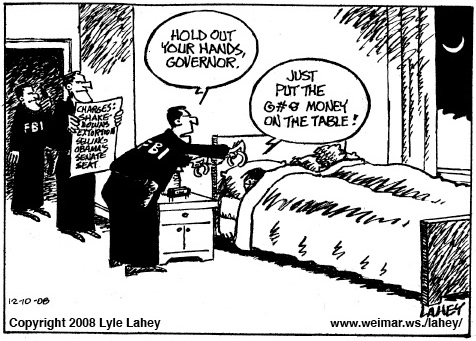
In what is becoming the de rigueur exit strategy from the Illinois governor's office, that state's governor, Democrat Rod Blagojevich, has been "taken into custody" by federal agents in connection with an investigation into Blago (as he's sometimes known) trying to "sell" the U.S. Senate seat being vacated by President-Elect Barack Obama.

Blagojevich's arrest comes not long after he tried to get President George W. Bush to commute the prison sentence of his predecessor in the governor's mansion, Republican George Ryan. Ryan is serving a six-year sentence on federal charges of racketeering and fraud.

Blagojevich's alleged crimes include trying to extort money from people wanting to do state business, trying to get money and other considerations in return for appointing someone to fill in the remainder of Obama's term in the Senate, and withholding state help from the Chicago Cubs, who were trying to sell ol' Wrigley Field.

If you're a Chicago White Sox fan like I am, then that last charge is understandable. But the rest of the charges are jaw-dropping, and they are not the first to be aimed at Blago. Read this major article in Chicago magazine (which, like the Chicago Tribune, the LA Times, WGN TV and Radio, and much more, is owned by the Tribune company, which recently filed for bankruptcy).

If you're at all a clean-government devotee, then this latest development can do nothing to improve the historic image of Illinois as a den of political corruption.

12:43 pm ADDITION: The Wall Street Journal offers this handy listing of corupt Illinois governors. Clip it out and carry it around in your wallet.

Tuesday, September 30, 2008

Complete Video: Gov. Arnold Schwarzenegger on Climate Change, Finance Crisis

0 comments


Above, courtesy of our video partners at Fora.tv, is the complete video of California Gov. Arnold Schwarzenegger's sold-out speech to The Commonwealth Club. He spoke on the anniversary of AB32, the state's landmark global-warming legislation, and in a wide-ranging Q&A with Club Vice President Greg Dalton he discusses the global financial crisis, dealing with Detroit, his expectations for the next president, and much more.

Friday, September 26, 2008

Gov. Schwarzenegger and The Commonwealth Club

0 comments

In his opening remarks to The Commonwealth Club Sept. 25, 2008, Gov. Arnold Schwarzenegger cited his past appearances at The Club and explained why he associates The Commonwealth Club with good luck.

Gov. Arnold Schwarzenegger Tells Club Credit Crisis Can't Stop Climate Change Initiatives

0 comments

California Governor Arnold Schwarzenegger told a Commonwealth Club audience this afternoon that budget battles and financial crises should not be used as excuses to back away from the leadership position the state has taken to reduce greenhouse gases.

Touching on some of the hot-button issues of the day, he also promised to uphold his pledge to resist oil drilling off the coast of California. Part of the solution, he said, would be better, more fuel-efficient cars from Detroit. Schwarzenegger said Detroit complains about his moves to get a federal exemption that would allow California (as in years past) to set its own fuel economy standards; he recommended that the rest of the country adopt California's higher standards and that Detroit stop complaining and begin innovating and rolling out alternative energy cars.

Speaking on the second anniversary of AB32, California's landmark Global Warming Solutions Act, the Republican governor told a packed audience of more than 500 people that the state has benefited greatly -- and will continue to do so -- from investment in green technologies. He praised the bipartisan state leaders who created the bill, and he said his administration will continue to focus on areas ranging from cleaning up its shipping ports to building the hydrogen highway.

In a wide-ranging audience question-and-answer period moderated by Club Vice President Greg Dalton, Schwarzenegger responded to the ongoing talks in Washington, D.C., aimed at crafting a large-scale government intervention into the markets to try to calm worldwide credit and investment markets. The governor offered his support for government intervention in cases where the markets have failed, but he urged that the government "not try to pick the winners" when it invests money or tries to direct economic development.

Keep visiting this Commonwealth Club blog for more reports from the governor's speech, press reaction, and photos and videos.
CWC-Twitter