Showing posts with label leon panetta. Show all posts

Friday, May 21, 2010

Leon Panetta on the CIA, Intelligence Agency Politics

0 comments
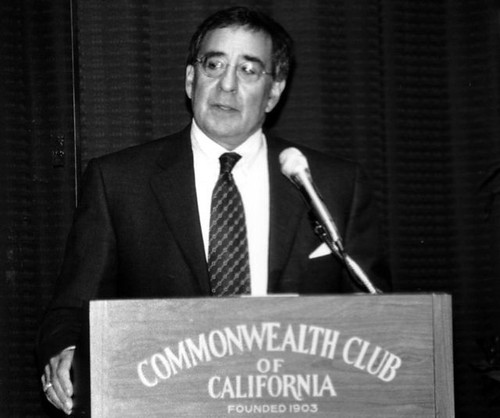
News reports on yesterday's resignation of Director of National Intelligence Dennis Blair have noted the sometimes testy relationship between Blair and Leon Panetta, the director of the CIA. When Panetta spoke at The Commonwealth Club on October 23, 2010, he was asked by Commonwealth Club President and CEO Dr. Gloria Duffy about their working relationship.

You can watch Penetta's response here, or watch the entire program with CIA Director Panetta:

Monday, January 4, 2010

White House Settles Dispute Between U.S. Spy Chiefs

0 comments

The White House has "issued a classified order to resolve mounting frictions" between the CIA and the national intelligence director, Adm. Dennis Blair, reports the Los Angeles Times. At issue was who had final authority in intelligence activities, including the conduct of covert operations.

The White House reportedly largely backs the CIA's desire to avoid more control by Blair, but the memo "includes language detailing the agency's obligation to work closely with Blair on sensitive operations," according to the Times.

CIA Director Leon Panetta alluded to the conflict during a recent presentation to The Commonwealth Club, but he suggested that he and Blair had a smooth working relationship. During his October 23, 2009, program, Panetta noted that lines of authority in the U.S. intelligence agencies hadn't been clear in the post-9/11 era. He said that Congress didn't develop "clear lanes in the road as to how the director of national intelligence and the CIA and the rest of the intelligence agencies" interact, and that led to years of conflict. "Having said that, both Admiral Blair and I have a good relationship," Panetta said. "We talk with each other, we try to ensure that we communicate on the issues that he is confronting. There clearly is a responsibility for a national intelligence director for coordinating the intelligence community.... At the same time, those of us who are within the intelligence community have to have the operational authority to do our job."

That interpretation doesn't sound far off from what Blair himself told The Club on September 15, 2009. He said that his job involves "setting priorities, providing leadership on the cross-cutting issues that affect more than one agency."

There was apparently significant room for disagreement within that larger umbrella agreement.

Watch parts of their presentations below, or members of The Commonwealth Club can read extensive excerpts from their programs -- plus FBI Director Robert S. Mueller III's October 7, 2009, program at The Club -- in the new issue of The Commonwealth magazine.


Monday, November 9, 2009

What's Your Opinion? National Debt and National Security

0 comments


In his recent speech to The Commonwealth Club, CIA Director Leon Panetta made a sobering case for redressing our country's long-standing practice of living beyond its means and driving up the national debt. As the San Diego Union Tribune wrote:

By far the most insightful speech we’ve heard of late from an Obama administration official came recently when CIA Director Leon Panetta addressed the Commonwealth Club in San Francisco. Panetta warned that if the federal government continued to run $1 trillion annual deficits – a very real possibilitygiven the blitheness of President Barack Obama and Congress about red ink –the national debt would become a threat to national security. The CIA boss makes a crucial point: An America that has to spend a quarter of its revenue just for interest on the debt is likely to be an America so weakened that it cannot protect itself from its enemies. Panetta said it was foolish to think “that we can remain a powerful nation” unless the United States lives within its means. He’s exactly right –and we hope he makes this argument to the president at the next Cabinet meeting.

 What do you think? Is our national debt a threat to national security? Why? What can be done about it? How should the country change that? Give us your opinion -- leave a comment below!

Thursday, October 15, 2009

The Intelligent Americans

0 comments

Next week, CIA Director Leon Panetta will discuss the future of national security in what will be one of the three safest talks at The Commonwealth Club in 2009 – the other two having already been given by FBI Director Robert Mueller earlier this month and by Director of National Intelligence Adm. Dennis Blair this past September. All events have more than your usual attention paid to on-site security. (At such events, one is tempted to advise attendees against making any sudden moves.)

The talks come at the end of a decade that has, for the American intelligence community, been tumultuous to say the least. Drastic changes following the events of 9/11, the challenges of pursuing Bin Laden and the host of problems presented by the Iraq war have given rise to the creation of the Department of Homeland Security, human rights violations, wire-tapping issues and, dare we mention it, a hunt for weapons of mass destruction whose existence was hotly contested.

The decade has also seen unprecedented cooperation between the CIA and the FBI – agencies whose odd-couple mismatch of culture and purpose appears to be rapidly dissolving in the face of threats both at home and abroad.

In one of the stranger developments in American counter-terrorism, there has been unheard-of outsourcing of erstwhile domestic operations (information gathering, law enforcement and cyber-crime prevention, etc.) to independent contractors. Though this has allowed for rapid, flexible responses to agencies' logistical problems, it is also responsible for the scandal surrounding Xe (the contractor formerly known as Blackwater).

During Panetta’s visit on October 23, we look forward to learning what the famously clandestine CIA sees as its biggest challenges going forward, and what it must do in order to meet them. More information on the upcoming talk is available at The Commonwealth Club's web site.

--By Andrew Harrison

Friday, January 9, 2009

Dr. Gloria Duffy blogs on Huffington Post

0 comments

Commonwealth Club President and CEO Dr. Gloria Duffy's recent posting on this blog about the nomination of Leon Panetta to be CIA director is getting an even wider audience. Today's Huffington Post includes the article by Dr. Duffy. You can read it here.

Wednesday, January 7, 2009

The Raging Debate over Panetta: Agent of Change or Agent of Status Quo?

0 comments

The choice of Leon Panetta for CIA's top man has certainly launched Washington and Washington-watchers into a cacophony of chatter. There seems to be little common ground between both arguments – he's not qualified or he's a proverbial breath of fresh air.

The former California congressman and chief of staff under President Clinton spoke at The Commonwealth Club of California's centennial celebration in 2003. During the question and answer portion of the program referring to the creation of the Department of Homeland Security, Panetta alluded to the organizational problems in the intelligence community. These same factors may have led to Panetta's appointment. (Read a transcript of Panetta's speech here.)

The Homeland Security Agency, without the FBI and without the CIA being part of it, still creates some of the same conflicts that we have seen before. The only way to resolve those conflicts is when the White House, the president of the United States, basically says, "Everybody operates as a team in getting this job done.

So the Washington chatter contest continues to rage.

Though it is correct that Panetta has no relative intelligence experience outside of Clinton's inner circle, the choice could be seen by some as nothing more than placing a Democratic ally at the post while the current bureaucracy continues to exist.

During the Vietnam War, President Lyndon Johnson became frustrated by consistent missteps by the CIA, according to the award-winning history of the CIA, Legacy of Ashes, by Tim Weiner. Johnson's solution was to install one of his Texas cronies, Admiral William Raborn to the post. Raborn proved ineffectual, lasting a mere 18 months, but Weiner writes the appointment was nothing more than a warm body. Johnson, according to the book, told Raborn he could be napping by noon. The more capable old hand at the CIA, future chief Richard Helms, would carry the load.

This leads us to today. This time around, the candidate likely perceived to have more qualifications is the Deputy Director Stephen Kappes. His problem may be his involvement in signing off the abduction and rendition to Egypt of suspected terrorist Abu Omar. One cynical line of thinking asks whether it is naive to believe that the torture and rendition of suspected terrorists or the extraordinary depths of the CIA's hand in world events will change greatly under Obama's administration. Though the breadth of the clandestine activity might subside under Panetta, his gravitas in Washington could allow for the CIA to conduct business-as-usual.

Since the CIA's creation under Harry Truman, it has proved troublesome for every president at one point or another. Maybe Obama is learning from the past and putting a friend in Langley?

Monday, January 5, 2009

Is Leon Panetta the Right Choice for CIA Director?

3 comments


I believe he is an inspired choice. Why? What the intelligence community needs most at this time is a firm management hand and strong ethical guidance, and Mr. Panetta has both. Not only has he managed the Office of the President as Chief of Staff for President Clinton, but he managed the budget process for all federal agencies, including the CIA, as Director of the Office of Management and Budget in the 90s. His contacts in Congress are excellent, from his years representing the Monterey Peninsula in the House, including as Chairman of the House Budget Committee - which reviewed and approved the CIA's budget. All of these roles, and his membership in the recent Iraq Study Group, give him the capability to succeed with the management and budgetary issues facing the intelligence community.

More important, the intelligence community has suffered through some poor choices in recent years. These have included yielding to what was probably political pressure leading the agency to mistakenly conclude in 2002-2003 that WMD were present in Iraq, and the decisions to use interrogation techniques that have not gone down well in our democratic society, no matter how justified our cause in combating terrorism.

These problems require a leader with a strong ethical compass, who will use good judgment in making key choices for the intelligence community. In addition to his prior government service that met high standards for good judgment and ethics, Mr. Panetta has spent the past decade thinking about leadership and ethics, teaching and lecturing about these topics, and training young people to engage in ethical government service through the Panetta Institute at Cal State Monterey Bay. He has the qualities of high moral standards and good judgement that are essential for the intelligence community at this time.

Concerns have been expressed that Panetta would be viewed as an outsider by the personnel in the intelligence agencies. But most CIA Directors for the past several decades have come from outside the intelligence community. They have included professors, businessmen and diplomats. Panetta is more of an insider than most of these folks.

It is also perhaps not widely known that there has been a major change in the intelligence agencies' personnel since 9/11. Some 50% of intel community staffers have joined since 9/11. This is not the hardened group of veteran analysts and operatives that it might have been in previous years, who perhaps would have protested or undercut the effectiveness of a director who was not "one of them". Many of the current staff are young and relatively new to the intelligence profession.

In addition, the intelligence community is involved in a makeover in how information is gathered, bringing into its practices the major developments from the civilian economy that have increased capabilities for finding and organizing information. For example, the intelligence community now has an "intellipedia", like wikipedia, where analysts from different fields and agencies can post and access information that previously would have only been accessible to a narrow range of people in a limited field.

Given this change in makeup and in its work process, I believe the intelligence community will welcome a man of Mr. Panetta's stature and capabilities as the fine leader who will secure their budgets and continue to improve their capabilities, while providing the moral compass to keep them out of trouble.

Besides all of this, Mr. Panetta's son, James, is a naval intelligence officer just awarded the Bronze Star for his work locating Al Qaida targets in Afghanistan.

I commend the choice of Mr. Panetta for this role, and wish him great success.

Gloria Duffy
President and CEO, The Commonwealth Club
Deputy Assistant Secretary of Defense, 1993-1995
CWC-Twitter