Showing posts with label President Bush. Show all posts

Wednesday, October 6, 2010

Condoleezza Rice Remembers German Reunification

0 comments
This month, Germany is celebrating 20 years since the reunification of East and West Germany.

Unlike British and French leaders at the time, the American administration of President George H.W. Bush encouraged the reunification of East and West Germany two decades ago, even if it wasn't sure how the details would all work out, says former U.S. Secretary of State Condoleezza Rice.

In an interview with German news magazine Der Spiegel, Rice says there was only a short window of opportunity when "the Soviet Union had to be strong enough to sign away its powers and rights but not strong enough to stop it." As a result, when the opportunity presented itself and West German Chancellor Helmut Kohl went full speed ahead with plans for bringing together the two parts of the nation separated by the Cold War, the Bush administration supported his fast-track approach.

In fact, there was apparently only one moment of disconnect between the White House and the chancellor's office, when Kohl didn't consult with his American counterparts before he presented a list of 10 points to guide the reunification process. But that speed bump was soon left behind, and Kohl and his plans remained in good standing with Washington.

Read the full Spiegel article for more on Soviet leader Mikhail Gorbachev's surprising role, the Bush team's worries about Kohl's re-election chances, the centrality of NATO to American comfort about German reunification, and more.

Condoleezza Rice will speak about her life, work, and family in a special event at The Commonwealth Club in San Francisco on Monday, October 18.

Wednesday, April 15, 2009

Pelosi Calls for Commission to Investigate Wall Street

2 comments
With an eye toward quelling the populist anger roiling across the nation, House Speaker Nancy Pelosi today called for the creation of a commission to root out the causes of Wall Street's meltdown patterned after an obscure Depression-era committee.

In San Francisco to speak about her book encouraging the rise of women in society at a gathering for the Commonwealth Club of California, Pelosi said Americans are angry with the economy and bonuses given to AIG, and at least 75 percent of them want an investigation into the missteps that led to this recession.


"That's what we would do with this commission, is to make sure it does not happen again," she said.


Pelosi spoke with Treasury Secretary Timothy Geithner this morning about the plan to emulate the Pecora Commission created in 1932. That commission, named after Deputy District Attorney of New York County Ferdinand Pecora, followed two failured attempts but ultimately benefited by Franklin Roosevelt's election to the presidency. The commission's findings led to the Securities Act of 1933 and the creation of the Securities and Exchange Commission – itself alleged by many to have been lax in regulating Wall Street (with Bernard Madoff's infamous Ponzi scheme being the poster boy for this age).


“Some people can tell you one piece of it. Others can tell you another piece of it. It's really hard to know. Do you understand it?” Pelosi asked rhetorically. “We need a clearer understanding of how we got here.”


Pelosi is not the first politician to allude to the Pecora Commission in recent weeks. Democratic Sen. Byron Dorgan called for a new iteration of the committee along with the resurrection of the Glass-Steagall Act, which separated commercial and investment banking. Many believe its repeal in 1999 was the impetus for banks and investment firms like Citigroup and Travelers to merge and allow the subprime credit markets to run rampant. (Wells Fargo Chairman Dick Kovacevich gave the banks' side of the deregulation story in a speech to The Commonwealth Club in 2008. Click here to view video.) A New York Times editorial last month also called for a Pecora-like commission to be created.


Besides making news with her call for a Wall Street investigation, Pelosi had a full schedule. Earlier in the day, appearing on the local Fox affiliate KTVU, Pelosi characterized an upswing of “Tea Party” tax protests as window dressing for elite conservative interests that mainly wanted lower taxes, mocking them as “Astroturf” or fake “grassroots.”

The Speaker also drew upon her personal biography to encourage woman to continue reaching for more positions of power. Her book, Know Your Power: A Message to American Daughters urges women to get involved in all aspects of community service. Pelosi is the daughter of the Baltimore establishment and said she found politics both exciting and distasteful. “It taught me I didn't want to be a part of it,” she said.


While raising five children with husband Paul Pelosi – who incidentally spent the speech doting over their newest grandchildr – she slowly became immersed in Bay Area politics with her big break occurring in 1976 when she secured Maryland for a youthful Jerry Brown in the Democratic presidential primaries. Pelosi joked, though, that the then-governor of California had a problem with saying, “thank you,” but he nonetheless found time to praise her for delivering Maryland to his campaign.

Thursday, April 9, 2009

Columnist Writes of the 'Real' Pelosi while real thing comes to Commonwealth Club

0 comments

E.J. Dionne's column in today's Washington Post sheds a quite divergent view of Speaker of the House Nancy Pelosi. It should be noted that Dionne is somewhat liberal and the idea of Pelosi as someone moving the country toward so-called "San Francisco liberalism" is a right-wing talking point. Nonetheless, the profile illuminates a possible congressional road map for the rest of the year.

Pelosi, in the article, lauded Republicans for voting with their convictions. The speaker is in a seemingly conciliatory mood as Congress heads into recess. It also helps that she will spend Easter at her Bay Area home before visiting the Commonwealth Club next Wednesday.

Pelosi told Dionne, "'The priority, of course, is to pass health care,' Pelosi said without blinking." The American Prospect's Ezra Klein notes in his blog that this is the first indication Pelosi sees health-care reform as a top priority over cap-and-trade.
To my knowledge, Pelosi hasn't said that before. More to the point, she's not signaled it. At a recent Maria Leavey breakfast, she implied just the opposite, and many folks I've spoken to on the Hill have suggested that her priority was energy rather than health care.
To reverse that specific perception, Pelosi seemed to be giving Dionne a lesson on congressional parliamentary procedure by saying she could muster 51 percent of the votes on health care under the rules of "reconciliation" where committees receive technical instructions on where and how funding will be budgeted. In effect, it's a promise that health care will be legislated but without specifics. Under the procedure, a bill only needs a simple majority, whereas a bill without reconciliation needs a more problematic 60 votes in the Senate. Pelosi also referred to the diversity of the party that also has the support of some coal-producing states. She showed Dionne a statue of a coal miner in her office given to her by a West Virginia congressman.

Dionne also mentions the recent relaxing of Republican attacks against Pelosi. With President Obama's post-election popularity too strong to spar with, Republicans targeted Pelosi without abandon. An article on Politico from last November claimed that the tactic has failed every time it has been utilized: "It didn’t work in 2006, and it’s not working this year, yet many Republicans continue to use Pelosi power as the ultimate threat to American governance."

Presumably, with a bit less than 100 days of the Obama presidency to work with, Republicans are turning their criticism toward the White House. Karl Rove ironically believes Obama is more divisive than President Bush (according to today's Wall Street Journal).

Despite the constant attacks on her leadership, Pelosi has proven to be a speaker unfazed thus far. Whether Pelosi can help th president push through Democratic-themed legislation like health-care reform is unclear, but it shows that it takes more pieces of the puzzle to assemble than one might think.

You can hear Pelosi in person at The Commonwealth Club on April 15 in San Francisco.

Wednesday, February 25, 2009

Bush Truth Commission on the Horizon?

0 comments
Will we see a replay of the 1970s-era Church Commission? What would that do for our political landscape?

Sen. Sheldon Whitehouse (D-RI) told Salon that some type of truth commission seeking to highlight Bush administration actions torture and other war crimes is imminent. According to the story, Whitehouse responded in effusive terms to a question of whether the public knows much about the past eight years. Here's how the reporter described his response: "His eyes grew large and he nodded slowly. 'Stay on this,' he said. 'This is going to be big.'"

In the current edition of Time, Sen. Patrick Leahy (D-VT), who chairs the Senate Judiciary Committee of which Whitehouse is a part, called for a truth commission modeled in part by the Church Commission of the early 1970s, which uncovered illegal surveillance methods by the CIA and FBI. In light of a divided electorate, Leahy believes Americans need to know the truth, saying, "Rather than vengeance, we need an impartial pursuit of what actually happened and a shared understanding of the failures of the recent past."

Sen. Frank Church, whose commission ultimately led to the creation of the Foreign Intelligence Surveillance Act (FISA), spoke in similar terms during a speech at The Commonwealth Club in 1975:

[Intelligence agencies] must function in the most delicate of all realms: mandated to maintain security without impairing freedom. if they engage in wrong-doing, it is not a casual matter that can be safely swept under the rug....

If we fail to restore a proper regard for the common good within the framework of the law, then creeping anarchy will gradually replace the rule of law altogether. In its wake will surely come the repressive measures that frightened people will then find preferable. There can be no successful preservation of liberty outside the law.


Since 2006, when the Democrats gained a majority in Congress, many liberals have criticized Speaker of the House Nancy Pelosi for failing to push for congressional hearings of alleged indiscretion or for impeachment of President Bush. Last week, Pelosi told Rolling Stone she believes senior Bush administration officials could be prosecuted: "The American people deserve answers."

But today Pelosi sounded less enamored with Leahy's proposal, because of the possible inclusion of immunity. In an interview today with Rachel Maddow of MSNBC, the speaker said, "What I have some concern about, though, is it has immunity. And I think that some of the issues involved here, like the services part, politicizing of the Justice Department, and the rest, they have criminal ramifications, and I don't think we should be giving them immunity."

Regardless of the political merry-go-round, it appears that some sort of hearings into the misdeeds of the Bush administration are squarely on the radar of Democrats.

Friday, February 20, 2009

Sanger: Iran Is a 'Few Screwdriver Turns' from the Bomb

0 comments
In David E. Sanger's new book, The Inheritance, the chief Washington correspondent for The New York Times writes, "the Iranians may be so close to a bomb -- a few screwdriver turns away -- that there is no hope of stopping the country from becoming nuclear capable."

In yesterday's Times, Sanger and William Broad reported the Iranians have created "more than a ton" of enriched uranium -- a third more than previously known, which the article cites as enough to build an atomic bomb. If the Iranians now have sufficient amount of enriched uranium, Sanger's assessment is proving quite prescient.

In the book, Sanger also writes Olli Heinonen, the International Atomic Energy Agency's chief inspector, saw 2008 as a "breakthrough year" for Iranian uranium enrichment capabilities. 

The summer before, Heinonen had predicted that by the end of 2008 the Iranians would likely be running upward of 4,000 of the high-speed machines [centrifuges] -- enough to make a bomb's worth of uranium in a year's time if they choose to enrich to bomb-grade purity. His prediction proved just about right.

While the new Obama administration has indicated its willingness to talk to Iran, the increased likelihood of a nuclear Iran could change some opinions in Washington, possibly allowing some hawkish members of Congress to revert to the previous administration's stated intentions to disrupt at any costs -- through sanctions or military action -- Iranian designs on creating a nuclear bomb.

The Bush administration had contemplated military airstrikes against Iran publicly since 2006, but Sanger reports in his book that the consensus for success was lacking. "Military experts who have studied the options say an airstrike could be devastating," writes Sanger, but also that it would not be quick. He quotes a former head of intelligence for the Middle East and the Defense Intelligence Agency as saying, "You are talking about something in the neighborhood of a thousand strike sorties and it would take all kinds of stuff -- air, cruise missiles, multiple airstrikes -- to make sure you've got it all." Some estimates, according to Sanger, have such a campaign lasting a week or two and making U.S. interests in the region vulnerable to attack from Hamas and Hezbollah.

Iran may have the enough nuclear materials, but they do not yet have a bomb. It is quite possible that the mullahs and President Mahmoud Ahmadinejad may not seek the actually warhead but merely seek what Sanger calls "a virtual bomb".

In the Second Nuclear Age, countries don't need to compile huge stockpiles of the sort that the Americans and Soviets amassed during the Cold War. All they need is a "virtual bomb," a credible capacity to build one in a few months and credible willingness to do so.

It appears the Iranians have achieved both points. How will President Obama react to this new nuclear paradigm?

Chief Washington Correspondent for The New York Times, David E. Sanger will discuss the challenges President Obama faces from Iran, Afghanistan, Pakistan, North Korea and China at The Commonwealth Club of California Wednesday, Feb. 25 at 6 p.m.

Wednesday, January 28, 2009

The Expansion of Conflict in Afghanistan

0 comments
MIDDLE EAST EXPERT THINKS WAR COULD BECOME "OBAMA'S VIETNAM"

The drumbeat of war emanating from Washington is not the deafening booms of a thousand timpani which led President Bush to invade Iraq, but the likelihood of expanding the war in Afghanistan sounds a bit like a smooth jazz rhythm -- cool and nuanced, a bit like the new president.

Defense Secretary Robert Gates testified to the Senate Armed Service Committee yesterday about the need to add 17,000 additional troops in Afghanistan within the next few months. On Friday, reports surfaced that President Obama ordered military drones to bomb Taliban extremists in northwestern Pakistan; the attack killed 22. Gates also reiterated the Status of Force Agreement signed by the United States and Iraq in June, which will leave Iraq bare of American troops by 2011.

The Obama administration's call for an expansion of involvement in Afghanistan comes as no surprise, despite calling the war in Iraq the wrong war. Throughout Obama's presidential campaign he was the only candidate who focused on Pakistan -- Afghanistan's neighbor to the south and enabler of the Taliban in the Waziristan region. Americans may have inadvertently bundled both conflicts into one and find the decision to send more troops to the regions a bit contradictory. But, isn't this what many liberal critics have always said about Bush's follies in the Middle East: The war in Afghanistan was justified, the war in Iraq was not. But the situation today is vastly different than 2002.

Noted Middle East expert Juan Cole says that a returning focus to Afghanistan could make it "Obama's Vietnam," meaning "Obama may be falling into the Lyndon Johnson Vietnam trap, of escalating a predecessor's halfhearted war into a major quagmire." Cole sees the recent attack on Pakistan without prior interaction with the government as a "bad sign."

It is not clear if Obama really believes that the fractious tribes of the Pakistani northwest can be subdued with some airstrikes and if he really believes that U.S. security depends on what happens in Waziristan. If he thinks the drone attacks on FATA are a painless way to signal to the world that he is no wimp, he may find, as Lyndon Johnson did, that such military operations take on a momentum of their own, and produce popular discontents that can prove deadly to the military mission.

Much of the conflict in Afghanistan is invariably intertwined with Pakistan and, to some extent, Iran. As William Dalrymple writes in a New York Review of Books article on author Ahmed Rashid's new book, Descent into Chaos, the Pakistani intelligence apparatus has a history of encouraging the Taliban in Afghanistan as a friendly bulwark against India, yet this association flies against its own self-interests.

It is for this reason that many in the [Pakistani] army still believe that the jihadis make up a more practical defense against Indian dominance than even nuclear weapons. For them, supporting a range of jihadi groups in Afghanistan and Kashmir is not an ideological or religious whim so much as a practical and patriotic imperative -- a vital survival strategy for a Pakistani state that they perceive to be threatened by India's ever-growing power and its alliance with the hostile Karzai regime in Kabul.

The Obama administration seems bent on resolving Afghanistan through Pakistan. This could take years, though. With a swift change in course comes apprehension for Americans weary of seven years of conflict. Out of that comes a question: Will Afghanistan threaten to gobble up the next four years like Iraq destroyed the Bush presidency?

--Steven Tavares

Is Afghanistan likely to become to Obama what Vietnam was to Johnson or Iraq to Bush? Is escalation in Afghanistan the right move? Did it work in Iraq? Leave a comment and join the discussion!

Friday, January 16, 2009

In Farewell Bush Is Unrepentant Until the End: A Personal Reaction

0 comments
President Bush looked tired. His hair gray. His neck visibly thin, barely filling his starched white collar. His farewell address last night revealed that certain charm that initially created a brief bond with a certain swath of America. He thanked Dick Cheney, had loving words for his wife, daughters and even mom and dad. You almost felt sorry for him. Some tender part of you might miss him -- maybe not his policies -- but his goofiness, his rebellious smirk and the ubiquitous notion of him as the Everyman-in-Chief.

Empathy for President Bush only goes so far, though. He can't hide from his cocky hubris. It is so much a part of his soul that he cannot stifle it. Many early news reports of the address focused on one quote: "We must never let down our guard." It was as if we were transported just for old-time's sake back to 2003 when the mainstream media walked in line with everything we now know was false about the invasion of Iraq. Bush is still fighting the terrorists while the rest of us are fighting the debt collectors.

Bush's retro bravado is not the most intriguing part of the speech. Instead, three sentences beforehand, he says, "America did nothing to seek or deserve this conflict." The United States did nothing to provoke the ire of the perpetrators of 9/11 and the Middle East? The line is a sharp jab in the eye to the entire region.

(For an earlier look into the president's thought process on defense and America's priorities, read the text of Bush's 2002 speech to The Commonwealth Club, or listen to the audio.)

If this was the rationale for the crumbling of the next six years, was it all worth it? I don't think so. Actually Bush's imperviousness to the facts is the hallmark of his presidency. His perception in a highly insular world allowed him to think he could repeatedly lead the nation wherever he wanted to take it, but like he once said, "Fool me once, shame on ... shame on you. It fool me. We can't get fooled again."

I don't think there was a singular event that caused al-Qaeda to attack seven years ago, but over 50 years of American intervention in the region. Arrogance that continually slapped the region's downtrodden adherents of Islam in the face, though in a usually covert manner, rarely as upfront as the style Bush preferred. The U.S. overthrew the democratically-elected leader of Iran because he wanted higher earnings from the oil he sold to the West. We have bankrolled the seats of power, at some point, of nearly every nation in the region, more often than not, propping up murderous despots who ruled their nations with iron-fists. Since seas of oil were first discovered on the Arabian Peninsula, it has always been about oil.

I think the U.S. did plenty to deserve 9/11. It did not deserve the loss of 3,000 innocent people, but then again, our government has not been very careful in differentiating insurgents from innocents, either. Bush long ago staked his presidency on the invasion of Iraq. By stubbornly clinging to the idea the U.S. was attacked without reason, the arrogance that so many Muslims sense from our government continues to permeate until Bush's last days in office.


--By Steven Tavares


Do you agree with Tavares that the U.S. provoked the 9/11 attack? Do you think President Bush is correct that it was unprovoked? Are you sad to see President Bush exit the national stage, or are you eager to have him gone? Leave a comment and share your thoughts!

Thursday, January 15, 2009

Suskind: Bush Lacked Humility for the Presidency

0 comments
FATHER/SON ISSUES MADE EVERYTHING PERSONAL FOR BUSH

The nation stands just four days away from inaugurating a new president. Of course, this is the glass is half-full argument. It sounds more uplifting than the glass is half-empty version manifested in the end of the troubled Bush presidency. Many journalists and television pundits have pressed to portray the inner psychological workings of George W. Bush. Filmmaker Oliver Stone bravely attempted to tell his story on the silver screen before time and history had made even a preliminary verdict on the last eight years.

Speaking last night at The Commonwealth Club, journalist Ron Suskind made one of the most astute observations that goes to the root causes of Bush's tumultuous time in the White House. During the Q&A portion of the program, Suskind was asked to name names at the CIA who were involved in creating faulty intelligence regarding WMD in Iraq. Suskind sidestepped the question, but he conjured a revealing portrait of a president both contemptuous of the office and unable to evolve as a leader. The following is an excerpt from last night's Suskind program:

I am absolutely of the mind there was plenty of information -- plenty -- with clarity that [had], at the very least, considerable doubts about WMD in Iraq. Eventually when all the documents on Iraq come out -- and they will, some of them I've seen, but now everyone will get to see them -- this will become crystal clear. This was not a mishap. This was not a oh, my goodness—shocked -- that there is gambling in Casablanca. It wasn't. It was never about the evidence, ever. That was part of the marketing department. How do we package it? How do we sell it.

Dick Cheney, to his credit, just a week ago said it would not have mattered had we not found any weapons. It wasn't about weapons. Now George Bush stuck to the old, tired script, “I'm disappointed” [in the voice of President Bush]. Disappointed? And where were you? Some of you are old enough to remember Harry Truman, I'm guessing. I wonder about that sign, “The buck stops here.” Where did the sign go? I heard [Paul] Wolfowitz took it to some cocktail party and left it there. You are a duly elected leader! Stand up in daylight! Be a mensch. This is an issue of character. My wife says, Don't be shrill. I try not to be! This is an issue of weak character. I hate to say that.

I wrote a piece in the New York Times. I went to Grant Park. Sort of the beginning of the Obama year and the end of the Bush years. I thought a lot about all the reporting I had done. And this whole Oedipal thing .... What's interesting about it is that, I think, I was looking at it in the wrong way. All this time, sometimes you can see thing at the end of it. Some folks say this whole period we could put a big headline, “Oedipal Rex”--w-r-e-c-k. I'm not writing that book.

In some ways what happened is that Bush never evolved when he got into office. We had this 9/11 and he was overwhelmed before that and then he dug deep and the faith-based presidency rises from that moment. He was confused. He was always overwhelmed. He was overwhelmed from the very start of the presidency.

You know, the fact is that he sat around corporate tables throughout his private life without anything to offer for a couple decades, while other people did the basic analytical work. He took a lot of things for granted. I've spoken to dozens of people about this.... He never had anything to offer. He would tell jokes. He would sit around saying, “I can't believe your wife let you out of the house with that damn tie on,” [doing an impression of President Bush]. He would fuss with people and use this non-verbal acuity to get leverage over them. He's real good at that. He's got real skills there, but imagine that being a mahogany table sitting in a boardroom at the Carlyle Group or in Texas or the Situation Room where you have to make a decision. That's scary.

He dug deep. He was scared. He never evolved. Presidents tend to. Almost all the ones we can name, [they] get into the Oval Office and it's humbling. You're a guy from Whittier. A guy from Independence, Missouri -- name a city. And you're in the round room and you've got to make decisions. Bush never evolved. Wy? Because he was so caught up in the father/son conversation. He wasn't humbled. He wasn't saying, “I better stay up late tonight because if I get this wrong, good God!” The consequences are overwhelming and dire. He always made it so personal. Whether it's "Tony Blair is a guy I can trust" or "Saddam tried to kill my dad" [doing impression of President Bush]. His issues. His dilemma. It's not about you. It's not about you. You sit there for a designated period of time as the leader of the free world and then you're out. It's a place that you're passing through. You do your level best. He never faced that.


If you have not seen the film, W., Suskind does in five minutes what Stone never quite accomplished in two hours.

--Steven Tavares


Is Suskind too hard on Bush? How would you characterize George W. Bush's performance in the most important job in the world? Leave a comment and share your opinion.

Wednesday, January 14, 2009

Suskind Stands by Allegation of Administration Forgery

0 comments
When it comes to adding infamy to the record of the Bush administration's misdeeds, Pulitzer Prize-winning journalist Ron Suskind has made it a cottage industry.

In his 2004 book, The Price of Loyalty, Suskind was the first to find evidence that the administration had the overthrow of Saddam Hussein on the brain starting with the first meeting of its National Security Council. Two years later, The One-Percent Doctrine, reported al-Qaeda's intention to attack New York's subway system and revealed Vice President Dick Cheney's belief that even a one-percent chance of a terror attack justified preparing for it as a certainty.

Suskind's newest book, The Way of the World: A Story of Truth and Hope in an Age of Extremism, published late last year, contains the most explosive allegation of all: the forging of documents by the administration during the run-up to the war in Iraq. Read a short Q&A with Suskind about the book for Men's Journal.

Despite the initial burst of attention the story garnered in the media it had a short shelf life. While the allegation has not been refuted, the notion administration officials could not have been irresponsible enough to put their indiscretions in writing -- certainly not White House stationary -- colored the story with enough doubt to sweep it under the rug.

(Watch Suskind on Hardball with Chris Matthews -- this day without the screaming host -- talk about the handling of the forgery.)

In a posting on The Huffington Post, Suskind fought the requisite blowback the administration would unleash on him by standing by his on-the-record interviews and his book saying:

So, here we go again: the administration is in full attack mode, calling me names, George Tenet is claiming he doesn't remember any such thing -- just like he couldn't remember "slam dunk" -- and reporters are scratching their heads. Everything in my book is on the record, with many sources. And so, we watch and wait....

Nevertheless, the story has not gained much traction in the months since and likely will merely join the endless pantheon of serious acts of malfeasance attributed to the Bush administration.

Ron Suskind will discuss his latest book on the Bush administration and provide an outlook on the road ahead for President-elect Barack Obama tonight at The Commonwealth Club of California at 6 p.m.


--By Steven Tavares

Do you think Suskind's disclosures merit more attention? Why hasn't it gotten it? Or do you think Suskind's disclosures are without merit? Leave a comment and voice your opinion!

Friday, January 9, 2009

The Stark Facts Behind the Rise in Unemployment

0 comments
Here are the disturbing facts and figures behind today's announced rise in unemployment to 7.2 percent:

The economy shedded nearly 2.6 million jobs in 2008, according to the Labor Department. This many jobs have not been lost since the 2.75 million at the conclusion of World War II. Three quarters of the total has occurred just in the last quarter alone.

The 7.2 percent figure represents the highest total in 16 years. The 584,000 jobs lost comes after the economy lost 524,000 in November of last year. To see the raw numbers from the Department of Labor, click here.

The number of unemployed Americans now totals 11.1 million. The figure may actually be higher since the Labor Department only tracks those looking for work during the last four weeks and cannot account for those intimidated by the bleak job market.

The comparison between President Clinton's two terms in office and President Bush's is stark and puts even more pressure on the incoming Obama administration. By the end of Clinton's presidency, the economy generated nearly 23 million new jobs, while Bush is slated to have created just over 3 million in eight years.

Within the numbers lies one devastating insight: things are likely to get worse. According to a Los Angeles Times report, those gainfully employed are losing more hours than before.

The report was full of ill portents. Among them was a reported decline in the number of hours worked to 33.3 hours per worker -- the lowest number recorded since the Labor Department began keeping track in 1964. Businesses tend to cut hours before cutting workers, so the declines likely mean more layoffs are pending.

This fact cuts directly to real-world problems affecting all Americans. While times are difficult for those laid-off recently or fruitlessly attempting to find work, those with employment are hurting as well.

Thursday, December 11, 2008

Report: U.S. Global Power Will Diminish By 2025

0 comments
A MULTI-POLAR WORLD SHARED WITH CHINA, RUSSIA AND INDIA PREDICTED

The National Intelligence Council (NIC) has a thought-provoking outlook for the the global geopolitical future in a report released last month. (A .pdf of the report can be downloaded here.)

In the report titled, "Global Trends 2025: A Transformed World", it predicts the United States will continue to sit atop world leadership, but with diminishing returns and "where power will be dispersed with newer player with new rules to the game."

Along with Russia and China, one of these new players will be India, which was the subject of a four-person panel last night at The Commonwealth Club.

The assessment sees both China and India regaining economic power not seen in those countries in two centuries and predicting both will rival the U.S. and Japan in Gross Domestic Product by 2025. Here are some of the other points the report makes regarding India:

-States such as India and other nascent countries may not espouse the Western-developed modes of governing, but are more likely to drift toward methods of "state capitalism" used in China.

-Rapidly modernizing nations like India will likely usher in a new sense of stability as their economic livelihoods will depend on it. It cautions, though, that Russian aggression may be an outlier to that situation.

-The report also imagines the Middle East and Asia without Western intervention as potentially a stumbling block to globalization. If the West and the United States, specifically, find the region a burden to their interests, a scenario could arise where China and Russia, despite differences, come to a tacit union, leaving Iran and India with no choice but to support them in the absence of Western support.

As Michael T. Klare wrote in The Nation, "Not only will the United States be weaker in 2025 because of the hubris of Bush and Cheney; it will face a world of multiplied dangers, emboldened challengers and a paucity of reliable allies."

If you don't want to read the 130-page report, that's the conclusion in a nutshell.

Friday, December 5, 2008

The Juice Is No Longer Loose

0 comments
SIMPSON WILL BE ELIGIBLE FOR PAROLE IN 2017

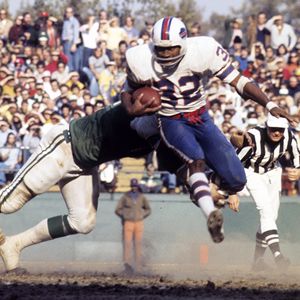
Is this the final act in the O.J. Simpson tragedy? Fourteen years after his infamous acquittal for double murder, the Hall of Fame running back was sentenced to a maximum 33 years in prison, though eligible for parole in 2017, for kidnapping stemming from an altercation in a Las Vegas hotel room last year. (Read Simpson's plea for leniency here.)

Many stories and blogs have skipped to the most interesting subplot of this story--namely, is this retribution for the perception of many that he slipped free from the hands of justice in the same way he dodged would-be tacklers in the NFL?

The entertainment blog at the Los Angeles Times, The Dish Rag, gets right to the point with the headline, "O.J. Simpson Sentenced to Jail Time. Finally!" with an exclamation point for good measure.

In an indication of Simpson's multi-platform stardom, sports bloggers from USA Today's Game On! include legal analysis on the judge's sentencing. ESPN's Lester Munson said, "this is a very stiff sentence," while adding, "Clearly the judge had no idea of leniency, or mercy or forgiving him for this robbery."

Though it adds nothing new to the discussion, the Washington Post actually has an NFL and crime blog called, NFL Crime Watch, which does not say much for the state of football and society when there is enough football players "gone wild" to justify its own blog.

Simpson's first go-around with the legal system ended more happily for the man known as "the Juice." His acquittal of charges of murdering his ex-wife and Ronald Goldman divided the nation along racial lines. Many believe Simpson literally "got away with murder."

In a 2002 speech at The Commonwealth Club of California, Simpson's lead attorney, the late Johnnie Cochran, answered the ubiquitous query, "Did O.J. do it?" (Read Cochran's entire speech or here.)

I think he is innocent for the following reasons: Never before have I seen a case, and I'll work backwards, where one of the star witnesses pleads guilty to perjury during the course of the trial. Never before have I seen a case where so much of the evidence was tampered with.... I argued the case to the jury in good faith, because he always maintained he was innocent; I'll be debating and arguing this case forever, but that was pretty much it.

In many ways the initial stream of thought in the blogosphere is similar to the media circus Americans witnessed outside the Los Angeles County Courthouse in 1994.

Lee Stranahan at the Huffington Post is urging President Bush to pardon Simpson as a smoke screen until January 20, while another blogger posing as O.J. writes that the authorities should look into the death of William Shatner's wife because "he's a no-talent hack."

This may be the end of O.J. in American popular culture, of course, until the biopic of his life comes out in theaters Christmas Day 2020. Any guesses to who will play O.J.? Will Smith, maybe, or foul-mouthed child actor Bobb'e J. Thompson from the movie, Role Models?
CWC-Twitter